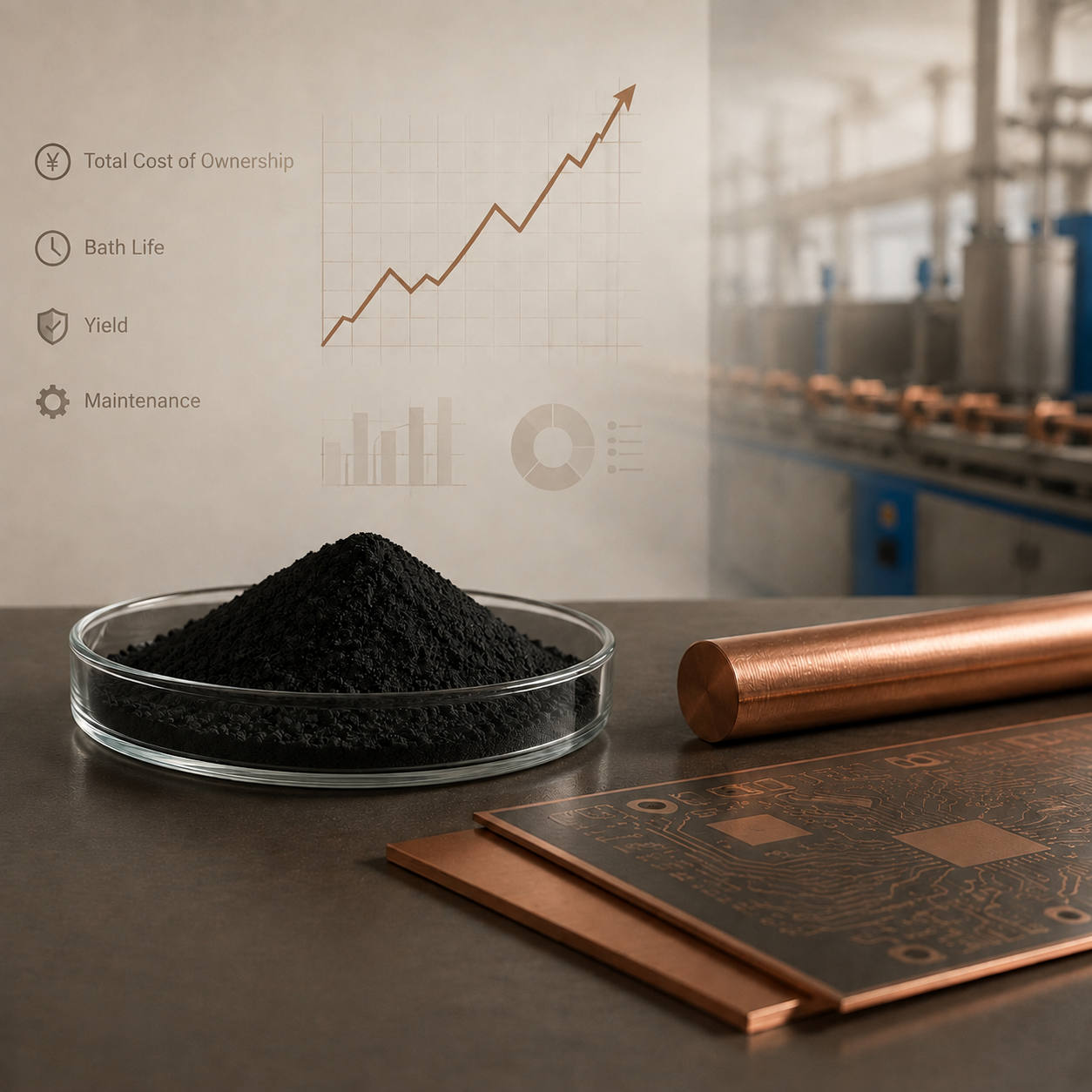
When Copper Prices Rise, Does Cupric Oxide Powder Have to Rise Too?
The Hidden Cost Elasticity Inside PCB Copper Plating Operations
Published: June 2026
Category: PCB Manufacturing | Cost Management | Copper Plating Chemistry
Reading Time: 8–10 Minutes
Key Takeaways
The way you calculate copper plating costs determines the conclusions you reach.
A 10% increase in copper prices does not automatically translate into a 10% increase in total plating costs.
In insoluble-anode acid copper plating systems, the quality of cupric oxide powder can influence plating bath life, maintenance frequency, downtime, and yield—often more than the raw copper price itself.
The largest costs in PCB plating are frequently hidden in process performance rather than material invoices.
Copper prices are rising again.
After briefly retreating from highs above USD 10,200/ton in Q1 2026, LME copper prices climbed back above USD 10,500/ton during Q2. Every time copper prices surge, PCB manufacturers receive similar notices from suppliers:
“Due to recent copper market fluctuations, pricing adjustments for cupric oxide powder will take effect next month.”
The assumption behind these notices appears straightforward:
Cupric Oxide Powder = Copper Value + Processing Cost
If copper goes up, the product price goes up.
But there is a flaw in this logic.
It treats cupric oxide powder as nothing more than a bag of copper atoms.
In reality, it is a process-critical material that influences plating bath longevity, maintenance schedules, filtration performance, and ultimately production yield.
That distinction changes the economics entirely.
Two Cost Models. Which One Are You Using?
Model A: The Purchasing View
Most procurement departments evaluate plating chemistry costs using a simple equation:
Copper Plating Cost
= Material Price × Consumption
+ Freight
+ Inventory Cost
Under this model, all cupric oxide powders are assumed to perform similarly.
The only meaningful variable becomes purchase price.
Optimization therefore means one thing:
Compare suppliers and buy cheaper.
Model B: The Process Engineering View
Process engineers often see a very different equation:
Copper Plating Cost
=
(Material Cost
+ Bath Maintenance Cost
+ Bath Replacement Cost
+ Yield Losses)
÷ Production Output
This model introduces three additional cost drivers:
Cost ElementHow Cupric Oxide Quality Affects ItBath MaintenanceMetal impurities increase additive consumption and adjustment frequencyBath ReplacementContamination accelerates bath aging and shortens service lifeYield LossesPits, roughness, and thickness variation increase scrap and rework
Both models describe the same production line.
The difference is that Model A lives in the purchasing department, while Model B lives on the shop floor.
Unfortunately, these two cost ledgers are rarely opened together.
Does Higher Copper Always Mean Higher Costs?
A Counterintuitive Example
Imagine two identical PCB plating lines.
Each consumes approximately 3 metric tons of cupric oxide powder per month.
Copper prices increase by 10%.
Suppliers raise prices accordingly.
Scenario 1: Looking Only at Purchase Price
Monthly material spending increases.
The conclusion appears obvious:
Costs went up.
Scenario 2: Looking at Total Cost of Ownership
Now introduce one critical variable:
Plating Bath Life
Supplier P
Acid insoluble content ≤ 0.03%
Typical industrial-grade material
Average bath life: 4 months
Supplier Q
Acid insoluble content ≤ 0.003%
Electronic-grade material
Average bath life: 6 months
For many PCB facilities, a complete bath replacement can cost:
Production downtime
Waste treatment
Fresh bath preparation
Additive replenishment
Typical total cost:
¥150,000–250,000 per replacement
Supplier PSupplier QBath Changes per Year32Annual Bath Replacement Cost¥450,000–750,000¥300,000–500,000Annual Difference—Savings of ¥150,000–250,000
In many cases, this saving alone exceeds the annual premium paid for higher-grade material.
The conclusion suddenly changes:
A 10% increase in copper prices does not necessarily increase total plating costs. If higher-quality cupric oxide extends bath life enough to eliminate even one bath change per year, total ownership costs may actually decrease.
Where Is the Hidden Cost Elasticity?
The hidden leverage typically comes from three areas.
1. Acid Insolubles: Paying for Residue You Never See
Acid insolubles are particles that fail to dissolve completely in the plating solution.
Electronic-grade cupric oxide powders may contain less than 30 ppm acid-insoluble material, while conventional industrial grades can be one or even two orders of magnitude higher.
The cost chain often looks like this:
Higher Acid Insolubles
↓
More Suspended Particles
↓
Greater Filter Load
↓
More Frequent Filter Replacement
↓
Downtime
↓
Potential Surface Defects
↓
Yield Losses
In many facilities, filtration-related downtime is treated as a maintenance issue rather than a raw-material issue.
However, the root cause may originate from the copper source itself.
A useful principle:
The cost doesn’t appear on the invoice. It appears in the maintenance log.
2. Metallic Impurities: The Invisible Timer on Bath Life
Every metallic impurity entering the plating bath follows its own degradation pathway.
Zinc (Zn²⁺)
Can co-deposit with copper and negatively affect deposit appearance and microvia filling performance.
Iron (Fe²⁺ / Fe³⁺)
Accelerates additive decomposition and is one of the most common drivers of premature bath aging.
Lead (Pb²⁺)
Even at ppm levels, can influence mechanical properties such as ductility and tensile strength.
What many operations overlook is that these impurities are cumulative.
Every addition of cupric oxide powder introduces not only copper ions but also trace metals.
Consider:
Monthly consumption: 3 tons
Electronic-grade material: ≤5 ppm Zn
Industrial-grade material: ≤50 ppm Zn
Over a year, the lower-grade material may introduce approximately 1.6 kg more zinc ions into the plating system.
That zinc does not disappear.
Its cost emerges gradually through:
Increased additive consumption
More frequent bath corrections
Earlier bath replacement
Because these costs are distributed across months of operation, they are rarely attributed back to the copper source.
That is what makes hidden costs dangerous:
They are real, but difficult to see.
3. Dissolution Performance: The Economics of Process Flow
When copper prices rise, many facilities focus on reducing consumption.
However, slow-dissolving cupric oxide can create localized Cu²⁺ concentration fluctuations inside the plating bath.
Operators typically compensate in one of two ways:
Adding more material
Waiting longer for dissolution
The first increases material consumption.
The second reduces throughput.
For advanced HDI processes, the real advantage of fast-dissolving electronic-grade cupric oxide is not simply that it dissolves 20 seconds faster.
It is that the dissolution behavior becomes predictable.
Predictable dissolution enables:
Stable Cu²⁺ replenishment
Consistent bath chemistry
Better process control
Improved first-pass yield
Speed is not about speed. It is about predictability.
Why Copper Price Volatility Is Actually the Best Time to Recalculate Costs
Many PCB manufacturers follow the same pattern:
Stable copper prices → continue purchasing as usual
Volatile copper prices → re-evaluate suppliers
Ironically, the opposite approach often makes more sense.
When copper prices are low, differences in material quality may appear insignificant.
When copper prices are high, every gram of wasted copper becomes more expensive.
Likewise, every bath replacement caused by contamination becomes more costly.
In other words:
Copper price spikes do not change the arithmetic. They amplify it.
The Information Gap Between Purchasing and Process Engineering
This discussion highlights a broader organizational issue.
In many PCB manufacturers:
Purchasing owns supplier selection.
Process engineering owns plating performance.
Finance owns cost reporting.
Each department sees a different dataset.
Purchasing focuses on unit price reduction.
Engineering focuses on bath stability and yield.
Finance focuses on overall manufacturing cost.
Without a shared Total Cost of Ownership (TCO) framework, important cost relationships remain hidden.
One principle repeatedly observed across industrial manufacturing is this:
Suppliers create the most value not by claiming their products are better, but by helping customers see costs they were not measuring before.
That is the purpose of this analysis.
Not to argue that one cupric oxide powder is superior.
But to provide a framework that places purchasing costs and process costs on the same balance sheet.
Final Thoughts
Copper price cycles are nothing new to the PCB industry.
Yet every cycle reveals the same pattern.
Companies that treat cupric oxide powder as a pure commodity during low-price periods often pay a higher price for that assumption when copper markets tighten.
Companies that evaluate plating operations through a Total Cost of Ownership lens frequently reach a different conclusion:
The more expensive copper becomes, the more valuable material quality becomes.
Copper prices do not define the lower limit of plating costs.
Material quality does.
About ZA Copper
ZA Copper specializes in the development and manufacturing of electronic-grade high-purity active cupric oxide powder for advanced PCB, FPC, and HDI copper plating applications.
Key product characteristics include:
Purity ≥ 99.5%
Acid Insolubles ≤ 0.003%
Rapid Dissolution (typically under 10 seconds)
Consistent Particle Size Distribution
Designed for Insoluble-Anode Acid Copper Plating Systems
If you would like to discuss plating bath optimization, request technical data sheets (TDS), certificates of analysis (COA), or evaluate potential TCO improvements in your plating operation, contact the ZA Copper technical team.