What Are U.S. AI Leaders Worried About? From Compute Costs to the Advanced PCB Supply Chain
Published: 2026-09-20|Category: AI Infrastructure and the PCB Industry|Reading Time: 14 min
Key Takeaways
U.S. AI companies are still expanding aggressively, but their leaders are speaking more openly about safety, capital returns, and infrastructure constraints.
The AI race now extends beyond models and GPUs to electricity, data centers, servers, networking hardware, and the electronics manufacturing supply chain.
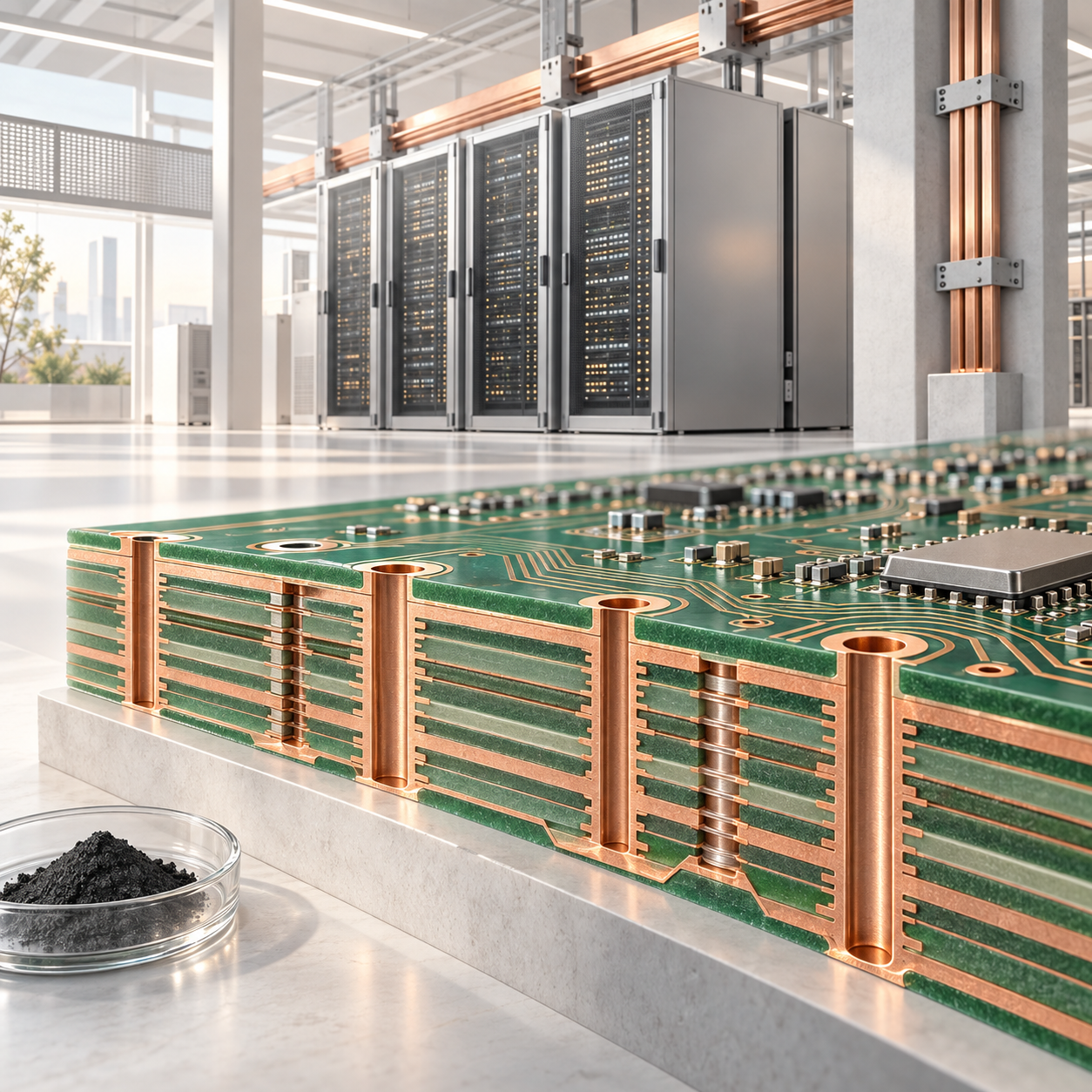
Greater compute density and faster interconnects are increasing demand for high-layer-count PCBs, backplanes, midplanes, and more difficult high-aspect-ratio hole structures.
For PCB manufacturers, uniform in-hole copper thickness, stable bath chemistry, and reliable copper replenishment are becoming more important.
Electronic-grade copper oxide is not a component inside an AI server. In some insoluble-anode acid copper-plating systems, however, it can provide an external source of Cu²⁺ used during advanced PCB manufacturing.
Concern within the AI industry does not necessarily signal the end of demand. It suggests that cost, efficiency, reliability, and supply-chain execution now matter as much as rapid expansion.
For the past several years, public discussion of artificial intelligence has centered on one question:
How capable can the next AI model become?
As the scale of AI training and inference grows, however, the conversation among U.S. technology companies is changing.
OpenAI, Anthropic, Microsoft, Meta, NVIDIA, and other industry leaders continue to invest in computing infrastructure. At the same time, they are speaking more frequently about safety, regulation, energy, construction costs, and returns on capital.
That may appear contradictory:
If these companies believe in the future of AI, why are they also warning about its risks and constraints?
The answer may not be that AI demand is disappearing. Rather, AI is evolving from a competition centered on algorithms and models into a large-scale infrastructure challenge.
Further progress depends not only on better software, but also on sufficient electricity, data-center capacity, processors, servers, network equipment, and a dependable electronics manufacturing supply chain.
1. What Are U.S. AI Leaders Worried About?
Recent public comments from U.S. AI executives generally fall into three areas:
whether safety and governance can keep pace with technical progress;
whether massive investments in compute infrastructure can generate adequate returns; and
whether power, land, data centers, and hardware supply can support continued expansion.
These issues appear different, but they point to the same transition:
The AI industry is moving from proving that advanced systems can be built to determining whether they can be operated safely, economically, and at enormous scale.
2. Concern One: AI Safety and Governance
AI safety remains the most visible part of the debate.
Leaders at OpenAI, Anthropic, xAI, and other U.S. AI companies have discussed the risks associated with increasingly capable models and called for appropriate oversight and governance.
The discussion includes questions such as:
Could advanced models be misused?
Can developers accurately evaluate new model capabilities?
Can safety testing keep up with rapid release cycles?
How should responsibility be divided between industry and government?
How can innovation continue without neglecting risk management?
These are important questions. For the industrial supply chain, however, there is another practical issue that receives less public attention:
Even if the models work, can the physical infrastructure required to run them keep pace?
3. Concern Two: Compute Costs and Returns on Investment
Training and operating advanced AI models require large numbers of GPUs, servers, networking systems, significant electrical power, and extensive data-center capacity.
The AI race therefore requires not only technical expertise, but also sustained capital investment.
AI developers and cloud providers must address several questions at the same time:
How quickly can newly installed compute capacity be utilized?
Will AI revenue cover the cost of infrastructure?
Can training and inference costs continue to decline?
Is the pace of data-center construction aligned with actual demand?
Will the cost of chips, power, and critical components continue to rise?
Can equipment produce an adequate return before a new generation replaces it?
The debate over an “AI investment bubble” is therefore not simply a debate over whether AI has value.
A more useful question is:
Can AI create economic value as quickly as infrastructure and operating costs are rising?
4. Concern Three: Can AI Infrastructure Be Built on Schedule?
AI infrastructure involves far more than purchasing a shipment of GPUs.
A large AI data center also requires:
reliable and sufficient electrical power;
suitable land and buildings;
cooling and thermal-management systems;
high-density server racks;
high-speed switches and electrical or optical interconnects;
power-conversion and distribution equipment;
large quantities of high-performance PCBs and electronic components; and
coordinated construction, commissioning, and maintenance.
OpenAI has announced a U.S. infrastructure objective of securing 10 GW of capacity by 2029 as it works to stay ahead of potential compute shortages. NVIDIA has also identified the availability of land, power, data-center shells, and capital as important conditions for AI infrastructure expansion in its public regulatory filings.
These disclosures show that chip output is no longer the only factor that can limit AI growth.
Grid connections, construction schedules, network reliability, and the ability of electronics suppliers to deliver qualified products on time can all affect how quickly new AI capacity becomes operational.
5. Why Is the AI Race Becoming an Infrastructure Race?
Earlier stages of AI competition focused heavily on model size, training data, and algorithms.
As AI moves into large-scale commercial use, the competitive criteria are expanding to include:
cost per unit of compute;
computing performance per watt;
data-transfer efficiency between GPUs;
server and rack density;
data-center construction time;
equipment reliability and serviceability; and
consistent delivery of upstream components.
The performance of an AI system is not determined by one GPU alone.
If data cannot move efficiently within a server, across a rack, or through the data center, even the most powerful processors can be constrained by networking and interconnect performance.
AI infrastructure development is therefore driving parallel advances in high-speed switches, optical modules, connectors, package substrates, and advanced PCBs.
6. Why Do AI Servers Need More Complex PCBs?
Compared with office computers and many conventional servers, AI systems typically operate with higher power density, greater data throughput, and more complex high-speed interconnects.
Their PCBs may have to accommodate:
more signal and power layers;
greater routing density;
tighter impedance control;
lower transmission loss;
more complex through holes, blind vias, and buried vias;
thicker boards and higher through-hole aspect ratios; and
stricter thermal and long-term reliability requirements.
As PCB layer count and thickness increase while finished hole diameters remain small, plated through-hole aspect ratios can rise.
During electroplating, solution must enter the hole and deposit the required copper thickness at the opening, along the wall, and near the center.
Unstable mass transfer, current distribution, or bath chemistry can contribute to:
excessive copper near the opening and insufficient copper near the center;
uneven thickness at different positions in the hole;
inadequate deposition in deep holes;
localized weakness or defects along the hole wall; and
greater reliability risk after thermal cycling.
The development of AI-server PCBs is therefore not simply a matter of adding layers. It also raises the requirements placed on drilling, electroless copper, electroplating, lamination, materials, and inspection.
7. Why Does Copper-Plating Stability Matter More in Advanced PCBs?
For high-layer-count PCBs with high-aspect-ratio through holes, surface copper thickness does not provide a complete picture of plating quality.
Manufacturers must also consider:
copper thickness near the center of the hole;
the difference between hole-opening and hole-center thickness;
copper distribution across different areas of the panel;
through-hole throwing power;
solution movement and mass transfer;
additive concentration and breakdown products;
stability of Cu²⁺ and sulfuric-acid concentrations;
current density and current waveform; and
consistency during continuous production.
As board structures become more demanding, process variation that was previously acceptable can become a source of in-hole thickness variation or reliability risk.
PCB manufacturers consequently need both capable equipment and tighter control of bath chemistry and incoming materials.
8. How Is AI Infrastructure Connected to Electronic-Grade Copper Oxide?
Electronic-grade copper oxide is not installed inside a GPU, an AI server, or a finished PCB.
Its connection to AI infrastructure is found in the PCB manufacturing process.
In some insoluble-anode acid copper-plating systems, the anode carries current but does not dissolve like a soluble copper anode to continuously replace Cu²⁺. As copper is deposited on PCB surfaces and hole walls, an external source is needed to replenish the copper ions consumed by production.
Suitable electronic-grade copper oxide can react in an acidic medium to provide Cu²⁺:
CuO + 2H⁺ → Cu²⁺ + H₂O
Reliable replenishment depends on more than CuO content. It also requires attention to:
metallic impurities such as Fe, Zn, Ni, and Pb;
chloride and other ionic residues;
acid-insoluble matter;
dissolution in sulfuric acid and in the actual plating bath;
particle size and powder dispersion;
consistency across consecutive lots; and
control of the feeding and dissolution equipment.
Excessive impurities or insoluble particles may increase bath-maintenance and filtration requirements during long-term use.
If dissolution in the actual plating solution is inconsistent, copper replenishment may lag behind production demand and make Cu²⁺ concentration more difficult to manage.
Growing demand for advanced AI-server PCBs therefore does not mean that every copper oxide product is automatically suitable.
The relevant question is whether the material performs consistently in the customer’s bath chemistry, equipment, and operating conditions.
9. What Does AI Infrastructure Expansion Mean for the PCB Supply Chain?
AI growth may require upstream manufacturers to do more than simply produce greater volume.
Suppliers may also need to provide:
higher technical specifications;
greater lot-to-lot consistency;
faster capacity response;
more complete traceability;
tighter cost control;
lower energy and material consumption; and
more dependable delivery.
This is one reason AI companies are paying closer attention to infrastructure economics.
At data-center scale, a small difference in the efficiency or reliability of one component can be multiplied across thousands of servers and years of operation.
The same logic applies to PCB production.
For a continuously operated copper-plating line, raw-material value should not be judged by purchase price alone. A meaningful evaluation also considers whether the material:
increases bath-maintenance frequency;
adds filtration load;
affects the response of copper replenishment;
requires more corrective adjustment;
supports stable continuous production; and
demonstrates consistent results across multiple lots.
10. Does Concern About AI Mean Demand Is Falling?
That conclusion would be premature.
U.S. AI companies continue to build models, data centers, and computing infrastructure even as they discuss safety, capital returns, and resource constraints.
The industry appears to be moving through a transition:
The priority is shifting from acquiring compute as quickly as possible to acquiring and operating it at lower cost, with higher efficiency and greater reliability.
Future AI infrastructure projects are likely to place more emphasis on:
data-center construction cost;
energy efficiency;
server-system reliability;
utilization of GPUs and network equipment;
resilience of the upstream supply chain; and
the life-cycle cost of critical components.
From this perspective, concern within the AI industry does not necessarily mark the end of expansion.
It may instead mean that the entire supply chain must move beyond speed and scale alone to deliver efficiency, quality, and sustainable capacity.
11. What Must Electronic-Material Suppliers Be Able to Demonstrate?
For an electronic-grade copper oxide supplier, growth in AI servers and advanced PCBs represents not only a market opportunity, but also a higher standard of qualification.
Customers may reasonably ask:
Is the copper feedstock clearly identified and traceable?
Can the supplier provide COAs from consecutive lots?
Are key metallic impurities and chloride controlled?
Is acid-insoluble matter consistent?
How does the product dissolve in the actual plating bath?
Is the manufacturing process operated within a stable control window?
Are particle size and activity consistent from lot to lot?
Can an abnormal result be traced to raw materials and production records?
As PCB designs move toward higher layer counts, higher aspect ratios, and stricter reliability requirements, meeting specification in one lot is only the starting point.
The ability to deliver comparable analytical and application results over time is an essential part of electronic-material supply capability.
Conclusion
The concerns expressed by U.S. AI leaders about safety, investment returns, and infrastructure reflect a new stage in the development of the industry.
Models remain important, but the power systems, data centers, servers, networks, and manufacturing capacity behind those models increasingly determine how quickly AI can be deployed in practice.
Expansion of AI infrastructure is supporting demand for advanced PCBs while raising expectations for in-hole copper thickness, plating uniformity, bath stability, and material consistency.
Electronic-grade copper oxide sits far upstream from an AI model. Through its use as a Cu²⁺ source in some insoluble-anode PCB copper-plating systems, however, it can form part of the manufacturing chain that supports advanced electronic hardware.
The AI industry must therefore answer more than one question:
How capable can the next generation of models become?
It must also answer a more physical and immediate question:
Can the infrastructure behind those models be manufactured and operated reliably, consistently, and economically?
For PCB and electronic-material suppliers, understanding this transition is more valuable than simply attaching an “AI” label to an existing product.
FAQ
What are U.S. AI leaders most concerned about?
Their public discussions cover AI safety and regulation, returns on compute investment, power and land availability, data-center construction, and the supply of chips and other hardware. Priorities differ among companies.
Would slower AI investment reduce demand for advanced PCBs?
Not necessarily. Even if some projects reassess their expected returns, AI servers, network equipment, and data centers still require significant electronic hardware. Future demand may place greater emphasis on efficiency, reliability, and total cost rather than expansion speed alone.
How are AI-server PCBs different from conventional PCBs?
AI-server PCBs may require higher layer counts, denser routing, more complex high-speed channels, greater power capacity, and stricter thermal performance. The exact design depends on the computing platform, switching architecture, and interconnect system.
Why does through-hole plating matter in high-layer-count PCBs?
As boards become thicker and through-hole aspect ratios increase, solution exchange and current distribution become more difficult near the hole center. Poor control can lead to insufficient center-wall copper or uneven thickness, increasing reliability risk.
Is electronic-grade copper oxide used directly inside an AI server?
No. Copper oxide is not retained in the finished server. Certain electronic-grade copper oxide products can be used as a Cu²⁺ source in insoluble-anode acid copper-plating systems during PCB manufacturing.
Why does AI infrastructure affect electronic-material suppliers?
Advanced servers and high-speed network equipment are driving more demanding PCB structures and manufacturing processes. This can raise customer expectations for material purity, lot consistency, application performance, traceability, and delivery reliability.
This article was prepared by the Zhongan Copper technical team.
Zhongan Copper develops and manufactures high-purity active copper oxide powder for electronic applications, including insoluble-anode acid copper-plating systems used in PCB, FPC, and HDI production.
Contact our technical team to request product specifications, a lot COA, particle-size data, sulfuric-acid dissolution results, plating-bath dissolution data, or sample-validation support.
Final product specifications and test results are subject to the COA for the delivered lot and the technical agreement confirmed by both parties.