Why Use Ammonia-Stripping to Make Electronic-Grade Copper Oxide Powder? A Comparison of Three Production Routes and Automated Process Control
Published: 2026-08-21 | Category: Copper Oxide Manufacturing & Applications | Reading Time: 16 min
Preview Summary
Electronic-grade copper oxide powder can be produced by several routes, including direct oxidation, copper-salt precipitation, and ammonia stripping.
The manufacturing route affects where impurities can be managed, how precursor particles form, and how consistently the final powder performs.
Ammonia stripping creates useful control points before CuO is formed—but it does not automatically guarantee high purity or low chloride.
This article explains the process and why Zhongan Copper combines electrolytic copper feedstock, ammonia stripping, and automated process control.
In our previous article, we compared three starting points for producing copper oxide powder:
copper-bearing process liquids;
scrap copper; and
electrolytic copper.
The feedstock sets the starting point for impurity control. But turning copper into black copper oxide powder also involves a series of chemical and physical transformations.
Those steps determine how copper enters solution, where impurities can be separated, how particles develop, and how the final powder achieves its required particle size, flowability, and dissolution behavior.
That naturally leads to the next question:
How is electronic-grade copper oxide powder actually made?
Industrial active copper oxide can be produced by several methods. The most common routes can be broadly grouped into:
Direct oxidation;
Copper-salt precipitation; and
Copper–ammonia ammonia-stripping.
Hydrothermal, sol-gel, and microemulsion methods are also used in laboratories and in specialized materials research, particularly for nano-sized copper oxide.
However, these methods are generally intended for nanomaterials, catalysts, or other functional materials. Their production scale, particle-size targets, and application requirements are not necessarily the same as those of industrial electronic-grade active copper oxide used in continuous PCB copper plating.
This article focuses on the three main industrial routes.
1. What Is the Ammonia-Stripping Process for Copper Oxide Powder?
Ammonia stripping is not a process of simply heating copper until it becomes copper oxide.
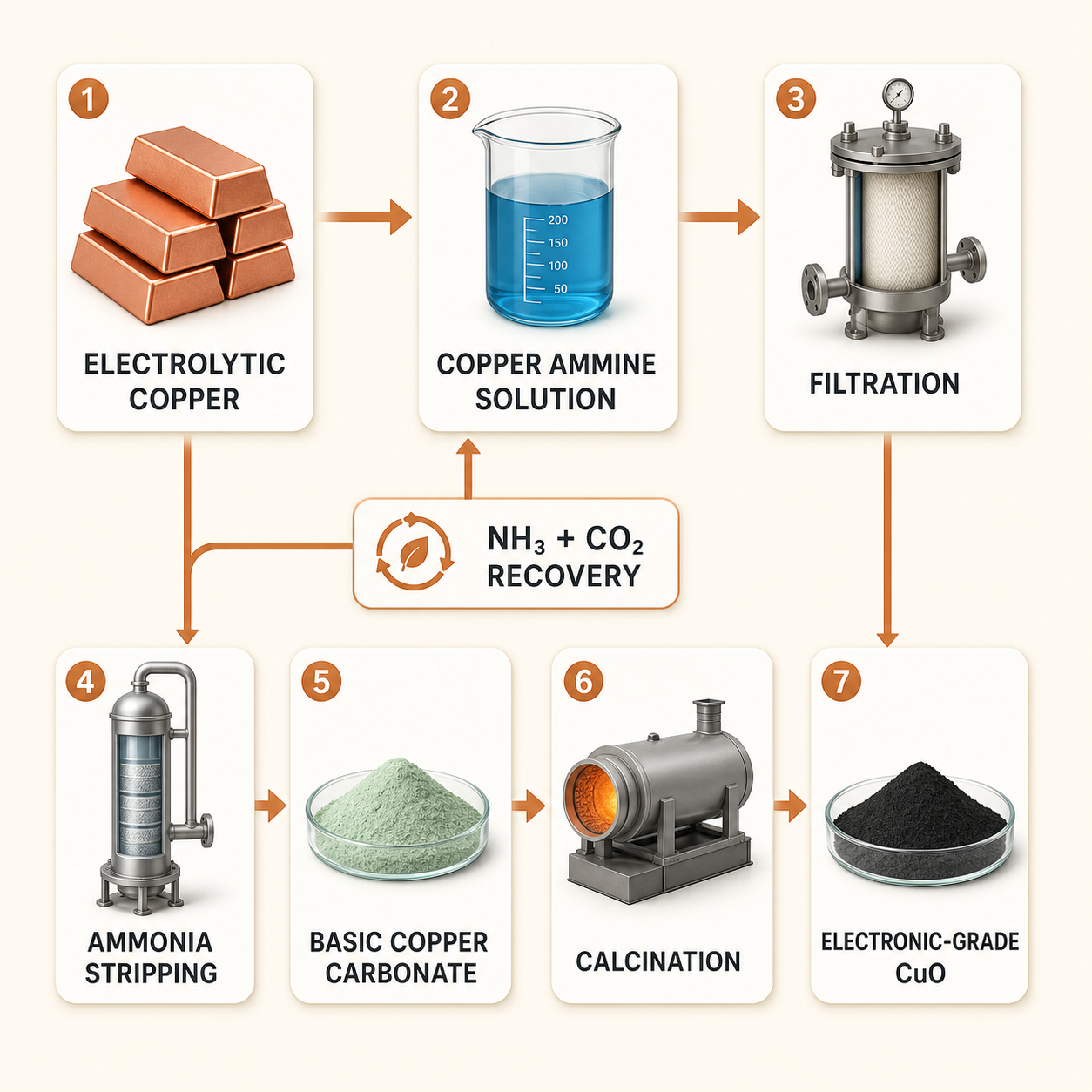
Instead, copper is first brought into a liquid system that can be filtered, adjusted, and monitored. Ammonia is then removed under controlled conditions, causing copper to re-precipitate as a solid precursor. That precursor is subsequently dried and calcined to form CuO.
When electrolytic copper is used as the starting material, the simplified process flow is:
Electrolytic Copper
↓
Copper Ammine Solution
↓
Filtration and Purification
↓
Ammonia Stripping and Precursor Precipitation
↓
Washing
↓
Drying and Calcination
↓
Screening, Testing, and Packaging
The flow looks straightforward, but every stage has a process window that must be managed carefully.
2. Step One: Converting Electrolytic Copper into a Copper Ammine Solution
Metallic copper does not rapidly dissolve on its own in ordinary aqueous ammonia.
Under suitable conditions involving ammonia, carbon dioxide, water, and oxidation, copper gradually forms soluble copper ammine complexes and enters the liquid phase. This step may be described as copper dissolution or copper conversion.
Key operating variables can include:
the surface condition and feed rate of electrolytic copper;
the ratio of ammonia to carbon dioxide;
solution temperature;
air supply or oxidation conditions;
reaction time;
agitation and gas–liquid contact efficiency;
copper-ion concentration; and
the reaction endpoint.
If copper concentration is too low, more liquid must be handled in the subsequent stripping stage, increasing time and energy demand.
If the dissolution stage is unstable, batches may differ in reaction time, copper concentration, or residual solids.
For this reason, the consistency of an ammonia-stripping process does not begin in the stripping vessel. It begins with stable copper dissolution.
3. Why Form a Copper Ammine Solution First?
This is one of the main differences between the ammonia-stripping route and direct solid-state oxidation.
Once copper is in the liquid phase, the manufacturer can introduce filtration and purification steps before the precursor is formed.
For example:
unreacted solids can be removed;
insoluble particles can be captured by fine filtration;
certain impurities that form precipitates under specific conditions can be separated from the copper ammine solution;
copper concentration and solution condition can be checked before the next stage; and
an abnormal batch can be identified before it becomes finished powder.
This “dissolve first, purify next, precipitate later” approach creates useful process-control space for electronic-grade materials.
It does not mean that every impurity disappears automatically.
Some ions that enter the copper ammine system may remain in solution. Feedstock quality, auxiliary chemicals, filtration performance, and subsequent washing are still essential.
4. What Happens During Ammonia Stripping?
The copper ammine solution enters the stripping system, where ammonia is gradually released by heating, sometimes together with reduced pressure and controlled agitation.
As free and coordinated ammonia are removed, copper no longer remains in the same stable complexed state in solution. It begins to precipitate as a precursor, commonly basic copper carbonate.
In simple terms:
Ammonia first helps bring copper into solution.
As ammonia leaves, copper precipitates again in a controlled solid form.
The released ammonia, carbon dioxide, and part of the water vapor can be condensed, absorbed, and prepared for reuse at the front end of the process.
This means ammonia stripping can function not only as a reaction step, but also as part of a material-recirculation system.
Important stripping-stage variables may include:
initial copper concentration in the copper ammine solution;
heating rate and stripping temperature;
operating pressure or vacuum level;
steam flow;
agitation speed and mixing pattern;
stripping duration;
changes in ammonia concentration, copper concentration, or pH;
reaction endpoint; and
ammonia condensation and recovery performance.
These variables can affect the precipitation rate and particle-growth behavior of basic copper carbonate.
If precipitation is too fast, more fine particles or agglomerates may form. If mixing or temperature distribution is uneven, particles formed within the same batch may develop differently.
Ammonia stripping is therefore not simply “boiling a solution.” It is a controlled precursor-formation stage.
5. Why Is Basic Copper Carbonate Important?
Basic copper carbonate is the key intermediate in the ammonia-stripping route.
Some of the important characteristics of the final copper oxide powder begin to develop at this precursor stage.
The particle size, porosity, degree of agglomeration, and particle-size distribution of the precursor can influence:
solid–liquid separation efficiency;
washing effectiveness;
caking behavior after drying;
particle structure after calcination;
powder flowability; and
acid dissolution and plating-bath dissolution behavior.
That is why stripping temperature, residence time, and mixing conditions cannot be judged only by whether the reaction is “complete.”
For electronic-grade copper oxide powder, the manufacturer must also consider:
Is the precursor forming in a stable, uniform, and repeatable way?
6. Filtration and Washing: Removing What Remains in the Mother Liquor
After stripping, the basic copper carbonate precipitates from the liquid phase and must be separated by centrifugation, filtration, or another solid–liquid separation method.
The freshly separated filter cake can still retain mother liquor on its surface and within its pores.
That mother liquor may contain:
residual ammonia;
soluble salts;
copper that has not fully precipitated;
trace ions introduced by feedstock or auxiliary materials; and
other soluble impurities.
The purpose of washing is to reduce these soluble residues as much as practical.
Water quality, number of wash cycles, liquid-to-solid ratio, filtration efficiency, and endpoint criteria can all influence ionic residues in the final product.
For this reason, low chloride should not be attributed to ammonia stripping alone.
When electrolytic copper, ammonia, and carbon dioxide are used as the main inputs, the process can reduce the risk of introducing chloride from copper chloride or ammonium chloride feedstocks. However, chloride can still be introduced by water, auxiliary materials, equipment residues, or cross-contamination.
The final result should always be verified by the COA for the delivered batch.
7. Drying and Calcination: Converting the Precursor into CuO
Washed basic copper carbonate is first dewatered and dried, then calcined under controlled conditions to form copper oxide.
The simplified decomposition can be expressed as:
Basic Copper Carbonate → Copper Oxide + Carbon Dioxide + Water
Calcination is not a case of “the higher the temperature, the better.”
Temperature, heating rate, residence time, material-bed thickness, furnace atmosphere, and cooling conditions can all affect:
whether the precursor decomposes completely;
CuO content;
degree of particle sintering;
specific surface area;
particle hardness;
subsequent milling requirements; and
acid and plating-bath dissolution behavior.
Insufficient calcination may leave the precursor incompletely decomposed.
Excessive calcination may make particles denser through sintering, reducing surface area, increasing the milling burden, and potentially affecting dissolution behavior.
For electronic-grade copper oxide, the objective is not simply high temperature. It is to establish a stable operating window between complete conversion and suitable powder activity.
8. What Other Manufacturing Routes Are Used?
1. Direct Oxidation
Direct oxidation uses metallic copper or copper powder as the feedstock and converts it directly into copper oxide under elevated temperature, air, or other oxidizing conditions.
Some processes first crush or atomize copper before oxidation. Others may use molten-copper spray oxidation.
Advantages
The chemical route is relatively direct.
It does not require a complete copper ammine solution system.
It avoids large-scale ammonia storage, recovery, and ammonia-specific safety management.
It can be suitable for large-volume production of certain industrial-grade copper oxide products.
Key Challenges
The degree of oxidation may be affected by particle size and gas–solid contact.
The conversion between Cu, Cu₂O, and CuO must be controlled.
High-temperature operation may require substantial energy.
Particles may sinter or become relatively dense.
Additional milling and classification may be required.
The approach to controlling particle size, porosity, and dissolution behavior differs from that of liquid-phase precursor methods.
Direct oxidation does not mean that high-quality copper oxide cannot be produced.
Its main difference is that impurity separation and particle development rely more heavily on copper feedstock quality, oxidation conditions, and downstream treatment, rather than on liquid-phase purification before precursor formation.
2. Copper-Salt Precipitation
Copper-salt precipitation typically starts with soluble copper salts such as copper sulfate, copper chloride, or copper nitrate. Sodium hydroxide, ammonia, carbonate, or another precipitant is then added to form copper hydroxide or a basic copper-salt precipitate.
The precipitate is filtered, washed, dried, and thermally decomposed to form copper oxide.
Advantages
The reaction principle is mature and widely used.
Equipment and production organization are relatively familiar.
Different copper salts and copper-bearing solutions can be used.
Precipitation behavior can be adjusted through pH, temperature, and addition rate.
The route can be applied to a range of industrial copper oxide and fine-powder products.
Key Challenges
When a copper salt reacts with a precipitating agent, soluble salts are formed in addition to the copper-containing precipitate.
For example, copper chloride reacting with sodium hydroxide creates sodium- and chloride-containing soluble species in the system.
These materials must be removed through solid–liquid separation and washing.
Some copper hydroxide precipitates can be highly adsorptive or gel-like, which may make filtration and washing more difficult and increase water consumption.
High-purity copper salts may be costly. If complex recovered copper-salt solutions are used instead, more pretreatment and impurity removal may be needed.
Key control points for the precipitation route therefore include:
purity of the copper salt;
ions introduced by the precipitating agent;
pH and addition rate;
precipitate morphology;
filtration performance;
washing endpoint; and
wash-water and wastewater management.
3. Solid-State or Copper-Salt Thermal Decomposition
Some copper oxide products can be made by direct calcination or thermal decomposition of copper salts, basic copper salts, or other copper-containing solids.
This route can be relatively simple, but usually requires elevated temperatures.
Main Characteristics
The processing steps are relatively simple.
It can be suitable for some general-purpose or specialized copper oxide products.
It offers flexibility in feedstock choice and equipment configuration.
The main challenges are energy consumption, particle agglomeration, sintering, and milling requirements.
For active copper oxide used in PCB plating, where rapid dissolution and stable particle size are important, the suitability of the resulting powder structure should be verified in the actual plating system.
9. Comparison of the Three Main Production Routes
Comparison ItemDirect OxidationCopper-Salt PrecipitationCopper–Ammonia / Ammonia StrippingMain feedstock formMetallic copper or copper powderSoluble copper-salt solutionCopper feedstock, ammonia, CO₂, and waterCopper conversion routeDirect solid-state oxidationPrecipitation followed by thermal decompositionComplexation and dissolution, ammonia stripping, then calcinationOpportunity for filtration before powder formationRelatively limitedDepends on purification of the copper-salt solutionFine filtration can be introduced after copper ammine solution formationMain ionic-residue riskDepends on feedstock and equipmentInfluenced by copper salt and precipitating agentInfluenced by feedstock, auxiliary materials, mother liquor, and washingMain particle-formation stageOxidation, sintering, and millingPrecipitation and calcinationStripping-stage precipitation and calcinationWashing requirementUsually lowerOften highThorough precursor washing is requiredHigh-temperature requirementSignificant during oxidationDuring drying and calcinationDuring precursor calcinationPotential for material recyclingDepends on equipment designMother-liquor and wash-water treatment are importantAmmonia and CO₂ can be recovered and recycledKey advantageDirect routeMature process and flexible feedstock optionsMore control space for purification, precursor growth, and circulationMain challengeOxidation uniformity and sinteringSalt residues, washing, and wastewaterEquipment investment, energy demand, and ammonia safety managementKey automation needsTemperature, atmosphere, and residence timepH, temperature, and addition rateRatios, copper concentration, temperature, pressure, mixing, and endpoint control
No single route is superior across every performance metric.
The right process should serve the application—not simply provide a more impressive-sounding process name.
10. Why Does Zhongan Copper Use the Ammonia-Stripping Route?
Zhongan Copper selected the ammonia-stripping route primarily because of the intended application.
Our electronic-grade copper oxide powder is designed for PCB, FPC, HDI, and related acid copper-plating applications. These applications require attention not only to CuO content, but also to:
metallic impurities such as Fe, Zn, Ni, and Pb;
chloride ion;
acid-insoluble matter;
dissolution rate;
particle size and powder flowability;
batch consistency; and
feedstock and finished-product traceability.
The ammonia-stripping route provides multiple process-control points for managing these requirements.
1. More Liquid-Phase Filtration Before Powder Formation
After electrolytic copper enters the copper ammine solution, filtration and in-process checks can be performed before stripping and precursor precipitation.
Compared with directly oxidizing solid copper into CuO, this provides more opportunities to identify and separate insoluble materials before finished powder is formed.
2. No Need to Use Copper Chloride as the Main Copper Source
Using electrolytic copper, ammonia, and carbon dioxide to establish the copper ammine system can reduce chloride input from chloride-based copper salts at the feedstock stage.
This supports low-chloride control, but the final chloride level still depends on auxiliary materials, equipment, washing, and batch-specific COA results.
3. Particle Formation Can Be Managed at the Precursor Stage
The stripping stage does more than remove ammonia. It is also where basic copper carbonate particles precipitate and grow.
By managing copper concentration, temperature, pressure, residence time, and agitation, the process can establish more stable precursor-formation conditions.
4. Ammonia and Carbon Dioxide Can Be Recycled
Ammonia and carbon dioxide released during stripping can be condensed, absorbed, and re-prepared for reuse in the copper-dissolution stage.
This can reduce material loss and emissions, but it requires reliable sealed equipment, condensation, absorption, and off-gas treatment.
5. Clear Process Stages Support Traceability
The ammonia-stripping route includes distinct stages: copper dissolution, filtration, stripping, washing, drying, and calcination.
If a finished-product result changes, these stages provide a structured path for reviewing feedstock, process conditions, and equipment records rather than attempting to work backward from the final powder alone.
11. Why Add an Automated Production Line?
Even when the same chemical principles are used, different batches can still produce different results.
Manual operation can introduce variation in areas such as:
feed quantity and feed timing;
heating rate;
steam-valve adjustment;
agitation speed;
operator judgment of the reaction endpoint;
washing time and water usage; and
calcination temperature profile and residence time.
The purpose of automation is not to remove process expertise. It is to execute a validated process window more consistently.
Zhongan Copper’s automated production approach focuses on the following areas.
Automated Formulation and Feeding
Electrolytic copper, ammonia, water, and related materials are added in a defined sequence and quantity, helping reduce variation from manual weighing and charging.
Critical Parameter Control
Operating ranges are established for temperature, pressure or vacuum, flow, agitation, and time. The system follows the required heating, holding, stripping, and transfer sequence.
Reaction-Endpoint Management
Reaction time, solution condition, and relevant process checks can be incorporated into transfer criteria, reducing reliance on operator judgment alone.
Equipment Interlocks and Safety Management
Ammonia requires rigorous management.
Automated valves, pressure control, condensation and absorption systems, alarms, and equipment interlocks can help the production line follow predefined safety logic during abnormal conditions.
Batch Data Recording
The automation system can record key process parameters and operating times, providing process evidence for COAs, investigation of abnormal results, and lot traceability.
It is important to be clear:
Automation does not automatically create purity, and it cannot turn an unsuitable process into a good one.
What it helps solve is a different issue:
Once a process window has been validated, how can each batch be made as consistently as possible?
12. “Ammonia Stripping + Automation” Is Not About One Single Specification
Zhongan Copper does not use ammonia stripping and automation simply to achieve a faster acid-dissolution number.
The broader objective is to manage several connected factors at the same time:
electrolytic copper reduces some feedstock-related uncertainty;
liquid-phase filtration helps manage insoluble materials;
ammonia stripping influences precursor-particle formation;
washing affects soluble ionic residues;
calcination affects CuO conversion and powder activity;
automation reduces process variation from batch to batch;
production records improve traceability; and
COAs and application testing verify the final outcome.
This is a quality chain extending from feedstock to process to finished product—not the isolated advantage of one machine or one reaction stage.
Conclusion
Direct oxidation offers a straightforward route. Copper-salt precipitation offers maturity and feedstock flexibility. The ammonia-stripping route offers more control space for liquid-phase purification, precursor formation, and material circulation.
At the same time, ammonia stripping requires more complex equipment, stricter ammonia safety management, and stable thermal and process control.
Zhongan Copper selected the combination of electrolytic copper, ammonia stripping, and automated production not because it is the simplest route, but because it supports our product objective:
Starting with a copper feedstock of defined composition and producing electronic-grade copper oxide powder under controlled, recorded, and traceable conditions.
A process name, however, cannot replace product verification.
Purchasers should still review multi-lot COAs, particle-size reports, dissolution data, and actual plating-line performance.
The most valuable manufacturing process is not the one that sounds most complicated. It is the one that can repeatedly deliver comparable results over time.
FAQ
Does ammonia stripping simply mean evaporating ammonia water to dryness?
No.
The purpose of ammonia stripping is to reduce ammonia concentration in the copper ammine solution, change the copper-complexation state, and precipitate copper as a precursor such as basic copper carbonate. Ammonia and carbon dioxide can then be recovered and reused.
Why is calcination still needed after ammonia stripping?
The stripping stage produces a basic copper carbonate precursor, not final CuO. The precursor must be dried and calcined to decompose into copper oxide, carbon dioxide, and water.
Does copper oxide made by ammonia stripping always dissolve faster?
No.
Dissolution behavior depends on feedstock, precursor structure, calcination conditions, particle size, agglomeration, and the test method. The relevant evidence is the measured result for the delivered batch under defined conditions.
Can direct oxidation produce electronic-grade copper oxide?
Yes, provided that feedstock purity, oxidation conditions, and downstream treatment are sufficiently controlled. Its quality-control focus differs from ammonia stripping and is more concentrated on oxidation completeness, sintering, and particle-size management.
Why can ammonia stripping support low-chloride control?
When the process uses electrolytic copper, ammonia, and carbon dioxide rather than copper chloride as the main copper source, it can reduce chloride input at the feedstock stage. Water, auxiliary materials, equipment, and washing must still be controlled, and the final result must be confirmed by the COA.
Can an automated production line make every batch exactly identical?
No process can eliminate all variation completely.
Automation helps reduce operator-related variation in feeding, temperature, pressure, flow, agitation, time, and transfer conditions. It improves repeatability and traceability.
How can a buyer assess whether a supplier’s ammonia-stripping process is stable?
Request COAs from consecutive lots, key impurity data, particle-size reports, acid-dissolution and plating-bath dissolution data. It is also useful to understand whether the supplier can provide feedstock traceability, process records, and investigation support for abnormal lots.
This article was prepared by the Zhongan Copper technical team.
Zhongan Copper uses traceable electrolytic copper as its primary copper feedstock and produces electronic-grade copper oxide powder through automated copper dissolution, filtration, ammonia stripping, washing, drying, calcination, and screening processes.
Contact our technical team to request product specifications, batch COAs, particle-size reports, or plating-solution dissolution data.
Final product specifications and test results are subject to the COA for the delivered lot and the technical agreement confirmed by both parties.