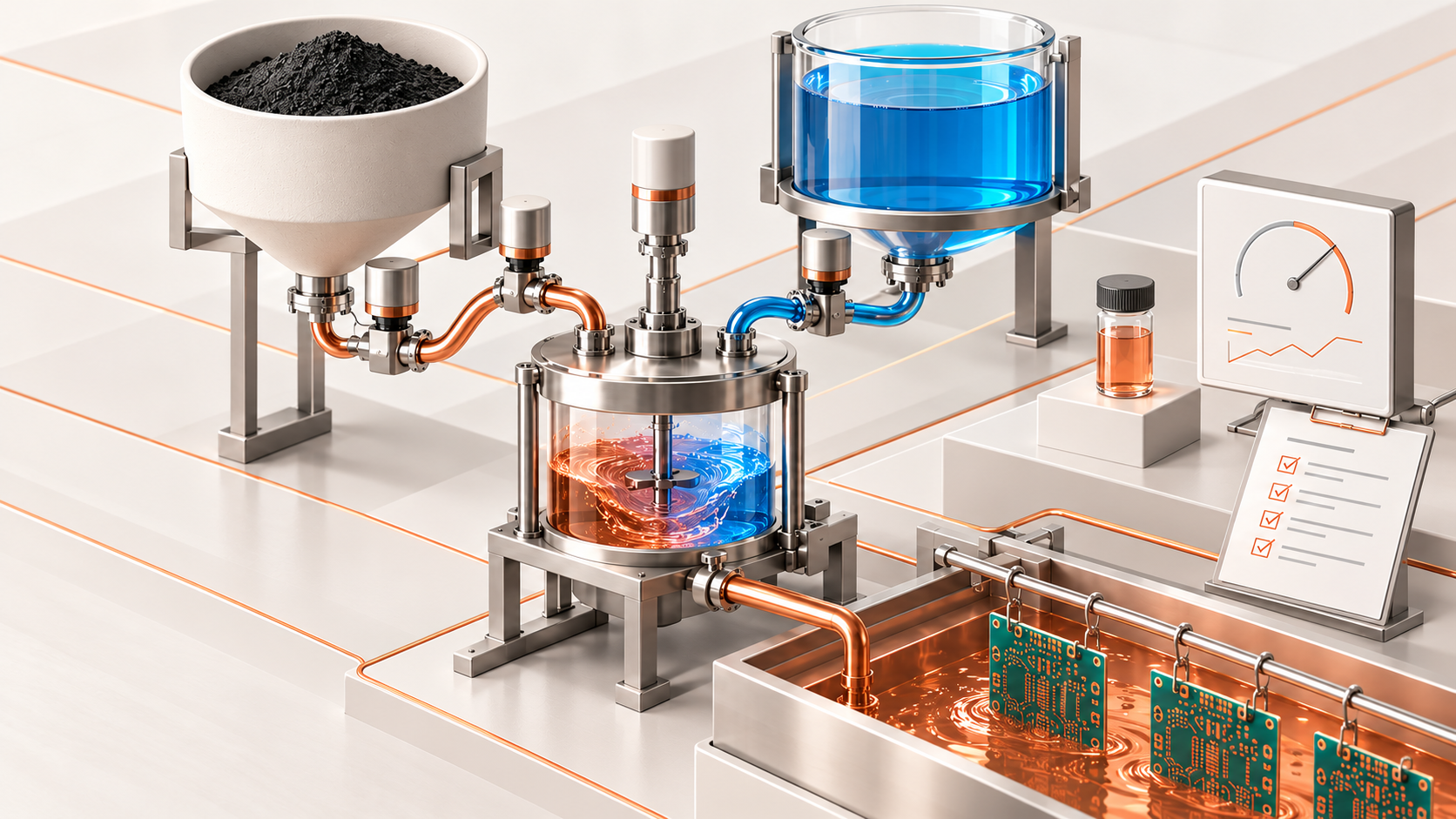
Copper Oxide and Copper Sulfate for PCB Acid-Copper Replenishment: Procurement Review Points
Publication status: 2026-10-17 | Category: PCB Plating Procurement Guide | Reading time: 8 min
For PCB acid-copper plating, copper oxide and copper sulfate cannot be compared independently of the plating line. Anode configuration, replenishment route, bath-control method, and qualification requirements determine whether purity, acid-dissolution data, or unit price are even comparable.
The procurement review should establish whether the proposed material can be introduced into the existing replenishment and control system, then assess impurity controls, lot documentation, and an agreed qualification method. Copper oxide and copper sulfate are not unconditionally interchangeable commodities across PCB acid-copper lines.
Define the replenishment architecture before comparing materials
The question “which is better, copper oxide or copper sulfate?” is common, but the plating line must first be defined. The relevant information generally includes:
whether the line uses soluble copper anodes;
whether it uses insoluble anodes with a controlled copper-source replenishment route;
whether external regeneration or make-up equipment is used; and
which equipment and procedures manage dosing, mixing, filtration, and copper-ion analysis.
These details define where a material enters the system, how it is controlled, and what must be verified. They are not secondary equipment details to be addressed after a quotation is received.
A published patent describes one replenishment route for an insoluble-anode acid-copper system in which CuO reacts with sulfuric acid to form copper sulfate and replenish copper ions:
CuO + H₂SO₄ → CuSO₄ + H₂OThis is a chemical pathway for discussion, not a universal bath formula, dosing rate, or replacement ratio for PCB plating lines. See the published process example.
The project role of CuO in an insoluble-anode system
In an insoluble-anode acid-copper system that has been designed and qualified for this approach, CuO can be evaluated as part of a controlled copper-source replenishment route. The assessment extends beyond adding powder to a tank; material properties, analytical methods, dosing equipment, and mixing conditions must be considered together.
An IPC technical paper describes a specific automated PCB acid-copper line that uses copper-ion analysis, a feeder, and an independent mixing area for CuO before replenished solution returns to the operating system. The example shows why material supply, analysis, equipment, and feed control must be evaluated together. It does not show that another line can duplicate the operating conditions or outcome. Read the IPC case paper.
For this reason, a useful supplier discussion begins with the operating system and control conditions, rather than a generic replacement ratio.
Procurement comparison points
Decision area | Questions for a CuO supplier | Questions for a copper sulfate or replenishment-solution supplier | Review purpose |
|---|---|---|---|
Existing line architecture | Is the intended application an insoluble-anode acid-copper system? Where will material be introduced and mixed? | What replenishment route and control points are already approved? | Materials must be assessed within the system that uses them. |
Bath and control method | Which bath conditions, analysis methods, feed approach, and acceptance limits apply? | Which solution grade, concentration basis, and established control method are required? | The comparison concerns a controlled replenishment method, not the product name alone. |
Impurity control | Which impurities, test methods, and reporting units are critical to the project? | Which trace-impurity controls and analytical records apply? | A broad purity figure does not replace an agreed impurity-control plan. |
Documentation | Are TDS, SDS, and applicable batch COAs available? | Are equivalent batch and safety documents available? | Documents support technical review, receipt, and lot traceability. |
Trial planning | Which sample, test method, and acceptance criteria are required? | Are the same qualification boundaries being used? | A trial should answer a defined process question. |
Zhongan Copper’s public electronic-grade CuO specification lists CuO content of at least 99.00% and controlled ranges for certain trace impurities. The applicable batch COA and the purchaser’s agreed project specification remain the governing documents for an actual delivery. Review the published CuO product information.
Acid dissolution and plating-bath compatibility are separate questions
An acid-dissolution test can describe a result under stated test conditions. It does not, by itself, demonstrate compatibility with a customer’s operating bath, additive package, dosing equipment, filtration arrangement, or production acceptance criteria.
When dissolution is part of the procurement review, the method and conditions should be confirmed before qualification. The review should also identify which result belongs in the acceptance plan. Acid dissolution and in-bath behaviour should not be treated as interchangeable evidence. See the distinction between acid dissolution and plating-bath dissolution.
Supplier review beyond a headline purity value
Purity is an important specification item, but it does not independently complete supplier qualification. A fuller review normally considers:
whether the product grade matches the intended application;
whether critical impurity limits are defined rather than only a total-purity value;
whether the delivery lot can be accompanied by an applicable COA;
whether the TDS and SDS are current and available in the project’s required language; and
whether the bath owner and process team have agreed the qualification conditions before sample introduction.
For PCB acid-copper projects, these points normally provide a stronger procurement basis than a single value in two product brochures.
Organizing a qualification trial
Establish the process boundary
Before samples are dispatched, identify the application, anode configuration, current replenishment method, bath owner, and any operating restrictions stated by the chemistry supplier.
Confirm document and testing requirements
Confirm the required TDS, SDS, applicable batch COA, impurity items, test methods, document language, and destination requirements. Third-party reports or specific reporting limits should also be identified at this stage.
Agree the acceptance method before testing
The test items, testing party, acceptable result, and intended use of the result should be agreed in writing. It should be clear whether a sample result is for initial screening only or can support a subsequent production approval.
Review project evidence before scale-up
A high stated purity does not establish readiness for volume supply. Scale-up should be assessed against the agreed specification and actual trial evidence.
Information to provide before sampling or requesting a quotation
current plating system and anode configuration;
replenishment method, analytical-control method, and known operating restrictions;
critical impurity limits and related testing requirements;
required TDS, SDS, batch COA, third-party report, or destination-specific documents;
sample quantity, delivery destination, and planned qualification timing;
estimated monthly volume after qualification; and
test methods and acceptance criteria to be agreed before production-order approval.
This information helps a supplier align documentation, samples, and technical communication with the project requirements.
Situations requiring project-level review
An article comparison should not be the sole basis for a purchase decision where:
a line is moving from soluble to insoluble anodes or changing replenishment equipment;
the bath-chemistry or additive supplier requires formal approval;
the customer has specific impurity, reliability, or documentation requirements;
the project will change an existing replenishment route; or
destination, transport mode, or document-language requirements remain unconfirmed.
In these cases, the comparison should move to a project review supported by the actual process requirements, lot documentation, and qualification evidence.
Scope of a procurement decision
Copper oxide and copper sulfate should be assessed as different material routes within a replenishment system, rather than ranked without reference to operating conditions.
For PCB acid-copper plating, a more reliable procurement decision is based on a defined line boundary, agreed impurity controls, batch-level documentation, and qualification under conditions close to actual use. An inquiry for electronic-grade CuO should state the plating system, anode configuration, current copper-source method, critical impurity limits, destination, expected monthly volume, and required documents. Suitability remains subject to the project’s actual process requirements.
FAQ
Is CuO a direct replacement for copper sulfate in PCB plating?
Not as a general rule. Suitability depends on the plating system, anode configuration, bath chemistry, feed and control method, and the approved qualification process.
Does a batch COA prove that CuO will be suitable for my plating bath?
No. A COA supports lot traceability and reports agreed test results. It does not replace bath-compatibility review or project qualification.
Which documents should be reviewed before purchasing electronic-grade CuO?
Review the applicable product specification, TDS, SDS, batch COA, critical impurity requirements, testing scope, and any customer- or destination-specific documents.
Related reading
Electronic-grade copper oxide PCB-plating specification and supplier review reference
Copper oxide acid dissolution versus plating-bath dissolution
Editorial source note: The published patent and IPC paper are used only to explain conditional process examples. They do not support a universal performance, cost, or process-compatibility claim for any buyer’s production line.