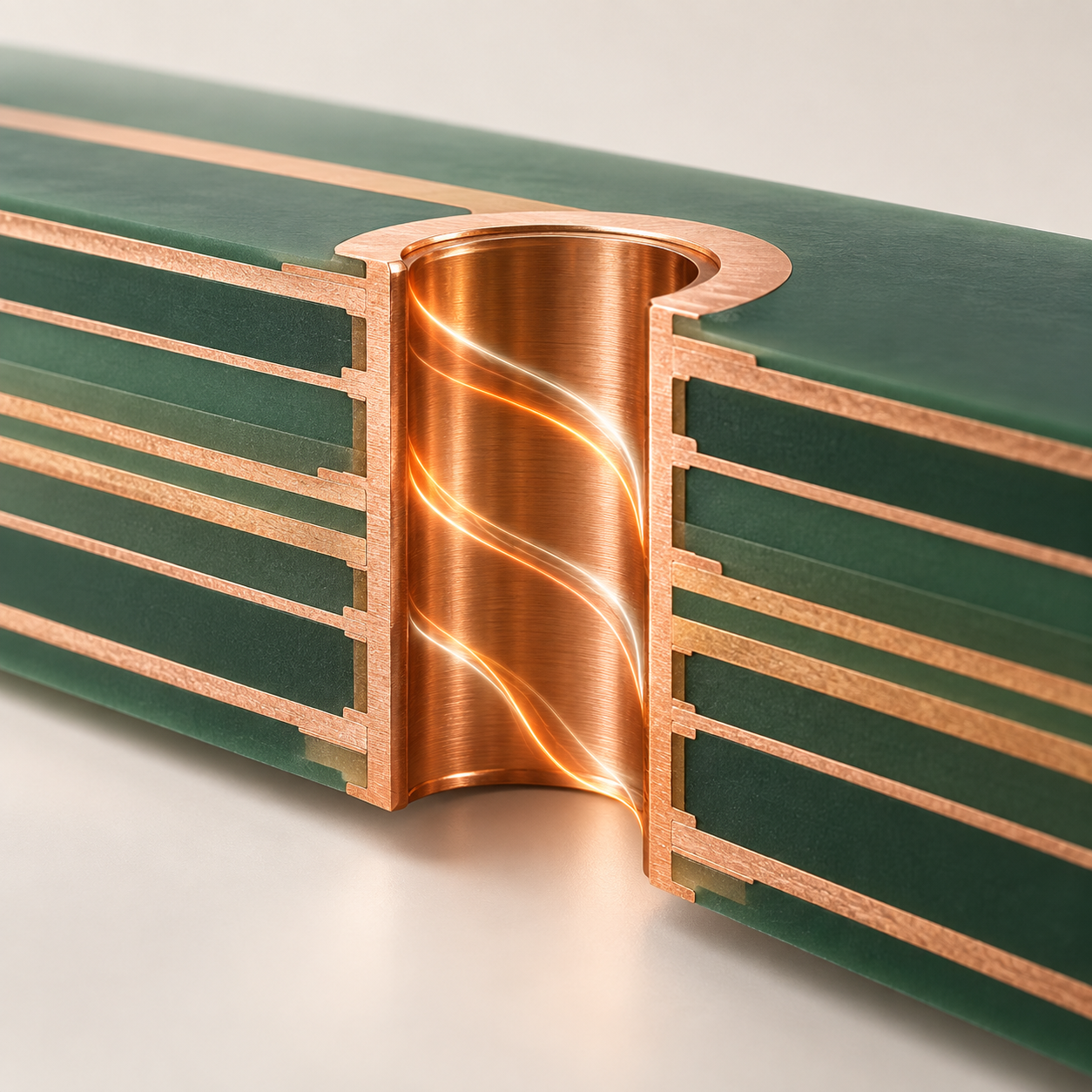
What Is PPR Copper Plating? Why High-Layer-Count Server PCBs Are Turning to Periodic Pulse Reverse
Published: 2026-10-06|Category: PCB Copper Plating and High-Aspect-Ratio Through Holes|Reading Time: 9 min
Key Takeaways
PPR stands for Periodic Pulse Reverse, a copper-plating method that combines forward pulses, reverse pulses, and, in some processes, rest periods.
Unlike DC plating, which applies current continuously in one direction, PPR adds more control over how copper is deposited across different areas of a PCB feature.
The value of PPR is not simply higher plating speed. It provides a broader process window for controlling copper-thickness distribution in high-aspect-ratio through holes.
As server PCBs become thicker and hole diameters become smaller, the center of the hole is more likely to become the limiting location for copper thickness.
PPR is not a stand-alone solution. Hole design, solution movement, additives, pretreatment, anode configuration, and Cu²⁺ replenishment must work together.
In some insoluble-anode systems, the dissolution consistency and impurity control of electronic-grade copper oxide can influence the response of the external copper-replenishment system.
As AI servers, switches, midplanes, and backplanes move toward higher layer counts, thicker boards, and more complex interconnect structures, through-hole copper plating becomes more difficult.
When board thickness rises while hole diameters remain small, solution exchange, current distribution, and copper-ion replenishment become more challenging near the center of the hole.
This can create a familiar result in conventional DC plating:
Copper builds faster at the panel surface and hole openings, while the copper layer near the hole center remains too thin.
To improve this thickness distribution, manufacturers of high-layer-count PCBs are increasingly interested in PPR copper plating—Periodic Pulse Reverse plating.
1. What Is PPR Copper Plating?
PPR stands for Periodic Pulse Reverse.
Instead of applying current continuously in only one direction, a PPR process alternates between different current stages within a controlled cycle.
A simplified PPR cycle can be represented as:
Forward pulse
↓
Rest or off time
↓
Reverse pulse
↓
Next cycle
In general:
the forward pulse deposits copper;
the reverse pulse adjusts the deposition process; and
the rest period can support diffusion, ion replenishment, and concentration redistribution.
Actual production waveforms can be much more complex than this illustration.
The forward and reverse current densities, pulse duration, frequency, duty cycle, and rest time all depend on the equipment, board type, bath chemistry, and process formulation.
PPR is therefore not a fixed set of values. It is a process-control approach that must be optimized with the plating bath.
2. What Is the Difference Between DC Plating and PPR Plating?
Conventional DC plating can be simplified as:
Current is applied continuously in one direction throughout the plating cycle.
This approach is mature, relatively straightforward to operate, and well suited to many standard PCB products.
In a high-aspect-ratio through hole, however, the opening and panel surface usually receive more effective current density. Copper ions and additives can also reach those areas more readily.
The center of the hole may face several limitations:
slower solution exchange;
a longer diffusion path for Cu²⁺;
different local additive behavior;
lower effective current density; and
a slower copper-deposition rate than near the hole opening.
The result can be a “thick at the opening, thin at the center” thickness profile.
PPR introduces time-dependent control through forward and reverse current stages.
With a suitable waveform and compatible bath chemistry, the reverse stage can moderate deposition in higher-current-density areas and help produce a more balanced copper-thickness distribution.
One point is especially important:
A stronger or longer reverse pulse is not automatically better.
If the reverse pulse is excessive or poorly matched to the chemistry, it can reduce plating efficiency, affect surface condition, or cause unwanted local dissolution.
3. Why Are High-Layer-Count Server PCBs Paying More Attention to PPR?
High-layer-count server PCBs may have to accommodate high-speed signals, power distribution, ground references, connectors, and control functions at the same time.
As the layer count and board thickness increase, through-hole aspect ratio can increase as well.
It can be expressed in simplified form as:
Through-hole aspect ratio = PCB thickness ÷ finished hole diameter
When the board becomes thicker while finished hole diameter remains unchanged—or becomes smaller—the hole becomes deeper and narrower.
For this kind of geometry, the challenge is not simply to deposit copper onto the hole wall. The goal is to create a sufficiently thick, continuous, and reasonably uniform copper layer throughout the hole.
Insufficient copper near the center of a high-aspect-ratio hole can increase the risk of:
plated-hole fatigue after thermal cycling;
changes in through-hole resistance;
reduced local connection reliability;
less reliable press-fit or mechanical connections; and
lower yield or reduced long-term product life.
PPR attracts attention not because it is a fashionable name, but because it gives engineers more ways to manage copper distribution in difficult through holes.
4. How Can PPR Improve In-Hole Copper Uniformity?
During DC plating, copper deposition continues as long as current is applied.
The panel surface and hole opening often plate more readily, while the center of a deep hole is limited by mass transfer and current distribution.
By changing the current state periodically, PPR can help in several ways.
1. Managing the Difference Between Hole Openings and Hole Centers
Under suitable conditions, the reverse pulse can have a more pronounced effect in higher-current-density areas.
This can help limit excessively fast copper buildup at the surface and hole openings, improving the relative balance for continued deposition near the center.
2. Changing the Diffusion Environment
Current switching and off time change the diffusion conditions near the electrode surface.
They do not automatically force solution into deep holes. Combined with agitation, solution flow, air sparging, or cathode movement, however, they can support improved local mass transfer.
3. Working with Additive Behavior
Suppressors, accelerators, and levelers in an acid copper-plating system influence deposition differently at different locations.
The PPR waveform and additive system must work together.
If the waveform is not compatible with the bath chemistry, PPR may not deliver the expected in-hole thickness profile.
4. Influencing Copper Structure and Surface Condition
Under appropriate conditions, pulse and reverse-pulse plating may influence grain structure, internal stress, and surface morphology.
The outcome depends on the formulation, waveform, temperature, current density, and board design. It cannot be predicted from the word “PPR” alone.
5. Which Parameters Must Be Controlled in a PPR Process?
PPR does not become stable simply because a pulse rectifier is installed.
Important control variables commonly include:
forward current density;
reverse current density;
forward-pulse time;
reverse-pulse time;
rest time;
waveform frequency;
duty cycle;
Cu²⁺ concentration;
sulfuric-acid concentration;
chloride concentration;
additive concentration and consumption state;
bath temperature;
solution circulation and spray conditions;
cathode movement or agitation;
anode configuration;
board thickness, hole diameter, and hole structure; and
plating time and target copper thickness.
These variables are interconnected.
For example, a waveform that performs well on one board design may not remain suitable after a change in hole diameter, board thickness, or required in-hole copper thickness.
The objective is not to find one universal waveform. It is to establish a process window that can be repeated, verified, and traced.
6. Can PPR Replace DC Copper Plating?
It should not be viewed that way.
DC copper plating remains mature, efficient, and suitable for many standard PCB products.
PPR is most relevant when a product needs additional control, for example:
high-layer-count PCBs;
high-aspect-ratio through holes;
high-reliability server and communications boards;
thick boards and large-format backplanes;
products with tight requirements for in-hole versus surface copper thickness; and
complex blind-via, via-filling, or specialized interconnect structures.
The decision to use PPR should be based on PCB design, hole geometry, available equipment, bath chemistry, target copper thickness, and reliability requirements.
An AI-server application alone does not automatically mean that PPR is required.
7. How Does PPR Relate to Automated Copper Replenishment?
PPR changes the current waveform. It does not replace the need for stable bath chemistry.
Whether a line uses DC or PPR, it must manage Cu²⁺ concentration, sulfuric-acid concentration, additives, and impurity levels continuously.
In certain insoluble-anode acid copper-plating systems, Cu²⁺ is replenished through an external copper-addition system.
Electronic-grade copper oxide can react in an acidic medium to form Cu²⁺:
CuO + H₂SO₄ → CuSO₄ + H₂O
If the replenishment material contains excessive impurities or acid-insoluble matter, or dissolves inconsistently in the actual plating bath, it may increase filtration load, delay replenishment, or add to bath-maintenance requirements.
For a high-load PPR production line, copper replenishment must remain aligned with the production rhythm.
A more complex waveform does not make copper-ion consumption and replenishment less important.
8. How Can Buyers Evaluate Whether a PPR Process Is Stable?
Buyers do not need to control every pulse parameter themselves. They can evaluate both the output and the process-management capability.
Useful items to review include:
copper-thickness measurements at different positions in the hole;
thickness difference between the hole opening and the center;
consecutive-lot data for the target board type;
thermal-cycle, thermal-shock, or other reliability results;
bath-analysis and copper-replenishment records;
additive-control practices;
raw-material COAs and traceability; and
corrective-action capability for abnormal lots.
The real value of a PPR process is not one exceptional hole-center result from a single test. It is the ability to deliver conforming boards repeatedly over time.
Conclusion
PPR copper plating gives manufacturers more process-control options for high-aspect-ratio through holes and high-layer-count server PCBs.
Through a controlled combination of forward, reverse, and rest stages, it can help engineers manage the difference in copper deposition between hole openings and hole centers.
PPR, however, is not an isolated technology label.
Final plated-hole quality still depends on whether the following elements remain coordinated and stable over time:
PCB design, hole geometry, bath chemistry, additives, solution movement, rectifier waveform, anode configuration, copper-replenishment capability, and raw-material quality.
For advanced PCB production, the key question is not simply whether a line uses PPR. It is whether the line can repeatedly deliver uniform, reliable, and traceable copper plating under real production conditions.
FAQ
Is PPR plating the same as pulse plating?
PPR is one type of pulse plating. It adds periodic reverse pulses to forward deposition pulses and may also include controlled rest periods.
Why can PPR help plate high-aspect-ratio through holes?
With an appropriate waveform and bath chemistry, PPR can help manage the difference between deposition near the hole opening and deposition near the center. The result still depends on hole geometry, additives, solution movement, temperature, and other process variables.
Is PPR always better than DC copper plating?
No. DC plating remains suitable for many standard PCB products. PPR is often considered for higher-aspect-ratio holes, thicker boards, high-layer-count boards, or products with stricter reliability requirements.
Which PPR parameters matter most?
Important variables include forward and reverse current density, pulse duration, duty cycle, rest time, Cu²⁺ and sulfuric-acid concentrations, chloride, additives, temperature, solution flow, and board geometry.
Can PPR solve thin copper at the hole center by itself?
No. PPR is part of a complete plating system. Hole design, pretreatment, solution flow, additives, anodes, and copper replenishment must also be controlled.
How does copper oxide replenishment relate to PPR?
PPR controls current waveform. In certain insoluble-anode systems, copper oxide can supply Cu²⁺ through an external replenishment process. Their functions are different, but both need to support stable bath composition and continuous production.
This article was prepared by the Zhongan Copper technical team.
Zhongan Copper develops and manufactures high-purity active copper oxide powder for electronic applications, including insoluble-anode acid copper-plating systems used in PCB, FPC, and HDI production.
Contact our technical team to request product specifications, a lot COA, particle-size data, sulfuric-acid dissolution results, plating-bath dissolution data, or sample-validation support for an insoluble-anode replenishment system.
Final product specifications and application results are subject to the COA for the delivered lot, the agreed test method, and validation in the customer’s production process.