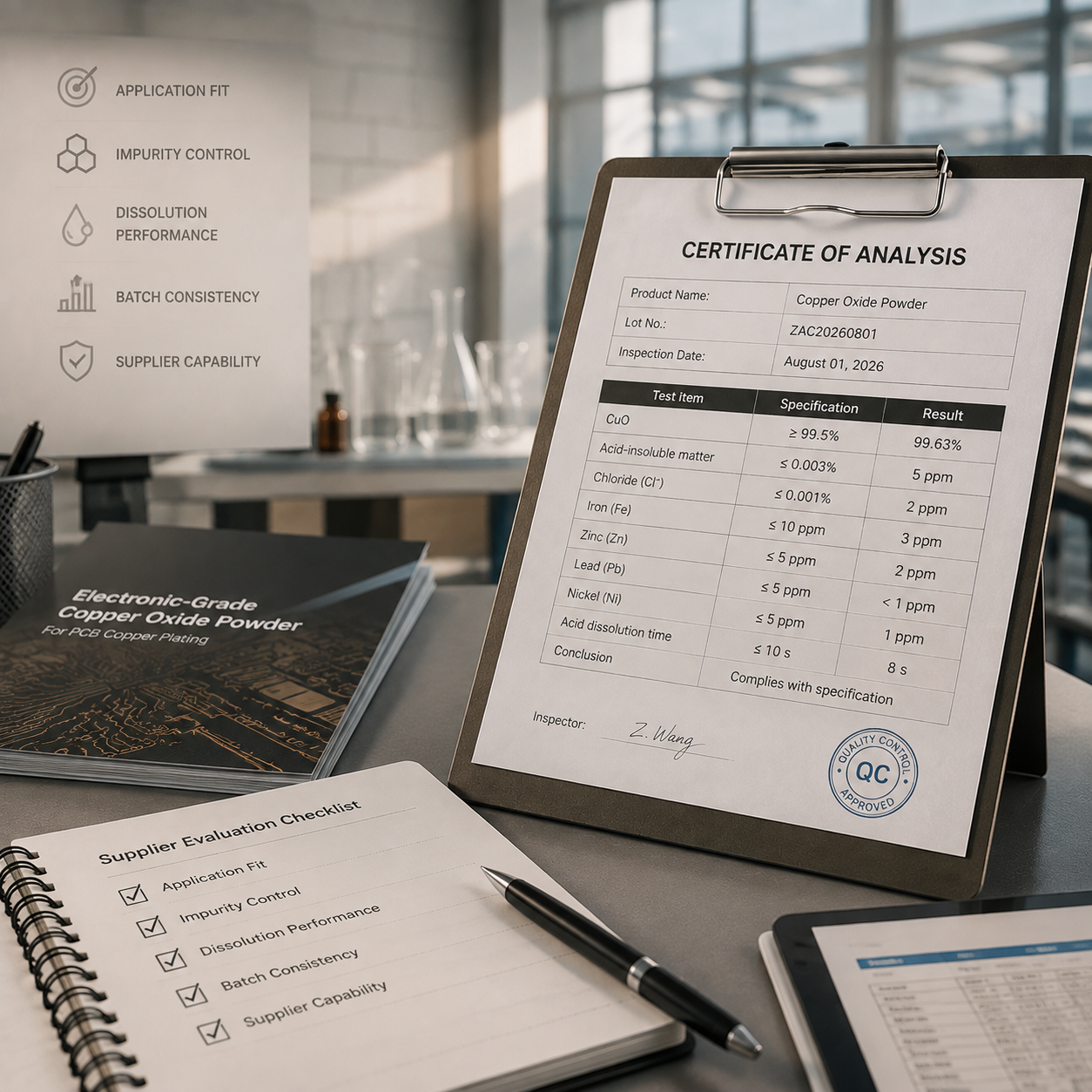
How to Choose Electronic-Grade Copper Oxide Powder: 5 Factors PCB Plating Buyers Should Evaluate
Published: August 08, 2026 | Category: Copper Oxide Powder Buying Guide | Reading Time: 6 min
Key Takeaways
Copper oxide powder should not be evaluated on price and CuO content alone.
Application fit, impurity control, dissolution performance, batch consistency, and supplier capability all matter in PCB copper plating.
A Certificate of Analysis (COA) is an essential quality document, but one compliant batch does not prove long-term consistency.
The right material is not necessarily the one with the highest headline specification. It is the one that performs consistently in your actual plating system.
When PCB manufacturers compare electronic-grade copper oxide powder, the discussion often begins with two numbers: price and CuO content.
Both matter, but neither fully answers the question that matters most on the production floor:
Will this material perform consistently in our copper plating process over time?
Two products may show similar CuO content while differing in trace impurities, dissolution behavior, batch consistency, and traceability.
Those differences may not be obvious during the first trial. Over time, however, they can affect bath management, filtration, copper replenishment, maintenance requirements, and overall process stability.
A practical supplier evaluation should therefore cover five areas.
1. Start With Application Fit
Not all copper oxide powder is designed for the same end use.
Industrial copper oxide is widely used in ceramics, glass, pigments, catalysts, and other applications. Electronic-grade copper oxide powder is typically controlled more closely for purity, trace impurities, dissolution performance, and batch consistency.
Certain electronic-grade CuO products are used as a Cu²⁺ replenishment source in insoluble-anode acid copper plating systems for PCB manufacturing.
Before comparing specifications, buyers should first confirm:
What process was the product designed for?
Is it suitable for PCB acid copper plating?
Does the supplier understand the intended bath chemistry and operating conditions?
Are relevant test reports and application data available?
Do the product specifications match the existing process requirements?
A compliant CuO content does not automatically make a product suitable for every copper plating line.
Specifications become meaningful only when they are considered in the context of the application.
2. Look Beyond CuO Content
CuO content is an important starting point, but it does not provide a complete picture of material quality.
If two products both meet the same CuO requirement, the next question should be:
What makes up the remaining fraction?
For PCB copper plating applications, buyers may also need to review:
Acid-insoluble matter
Chloride, or Cl⁻
Metallic impurities such as Fe, Zn, Pb, and Ni
Acid dissolution time
Dissolution performance under plating-bath conditions
These parameters matter because copper oxide powder does not introduce only Cu²⁺ into the process. Trace substances present in the powder may also enter the bath as the material dissolves.
This becomes more important in a continuously operated plating system, where raw material is added repeatedly over time.
Instead of asking only, “How pure is the product?”, buyers should also ask:
Which impurities are tested, what are the actual lot results, and how much do those results vary from batch to batch?
That provides a more useful picture than a single purity percentage.
3. Distinguish Specification Limits From Actual Lot Results
A common mistake when reading a copper oxide powder COA is treating the specification limit as if it were the measured result.
Consider the following example:
Test itemSpecificationActual lot resultAcid-insoluble matter≤0.003%5 ppm
The conversion is:
0.003% = 30 ppm
This means:
The maximum specification limit is 30 ppm.
The actual result for this batch is 5 ppm.
The two figures do not conflict. They describe different things: one is the acceptance limit, while the other is the measured performance of a specific lot.
Buyers will commonly encounter three types of product data:
Data typeWhat it meansSpecification limitThe acceptance boundary guaranteed by the supplierTypical valueThe level commonly observed across previous batchesActual lot resultThe measured result for the batch being supplied
These figures should not be used interchangeably.
For example, it would be misleading to compare one supplier’s typical value with another supplier’s maximum specification limit.
A more reliable approach is to request COAs from several consecutive lots. This makes it easier to evaluate both the average performance and the level of batch-to-batch variation.
4. Evaluate Dissolution Under Relevant Conditions
Copper oxide powder must dissolve before it can replenish Cu²⁺ in the plating system. Dissolution performance is therefore an important part of material selection.
Some suppliers report an acid dissolution time. This is a useful basic test, but it should be interpreted carefully.
Fast dissolution in a standard acid test does not guarantee identical behavior in every production plating bath.
Actual dissolution can be influenced by:
Cu²⁺ concentration
Sulfuric acid concentration
Temperature
Bath circulation and agitation
Dosing method
Other components in the plating chemistry
When reviewing dissolution data, buyers can ask:
What is the acid dissolution time?
Has the product been tested in a simulated plating bath?
What bath conditions were used?
Is the reported figure a specification limit or an actual lot result?
Are all batches tested using the same method?
Procurement teams do not need to become experts in every analytical method. They do, however, need to know whether the test conditions are clearly defined, repeatable, and relevant to the intended application.
A dissolution result without a test method or bath condition provides limited value.
5. Assess Batch Consistency and Supplier Capability
An excellent result from one batch does not guarantee that future batches will perform the same way.
PCB copper plating is usually a continuous production process. Changes in incoming material may require additional bath adjustment, testing, or process control.
When evaluating an electronic-grade copper oxide supplier, buyers should consider whether the supplier can:
Provide COAs for consecutive production lots
Trace raw materials and finished products by batch
Maintain consistent control ranges for critical parameters
Use stable and documented test methods
Identify the affected batch quickly when an issue occurs
Include critical parameters in a technical agreement
Provide particle-size and dissolution test reports
Support sample evaluation and small-scale production trials
Respond effectively to quality or application questions
Maintain reliable production and delivery schedules
For most PCB manufacturers, the greatest value does not come from one batch achieving the lowest possible impurity result.
It comes from receiving comparable, predictable results across many batches.
Consistency makes incoming inspection more meaningful, reduces uncertainty during qualification, and gives procurement, quality, and process teams a common basis for decision-making.
Supplier capability therefore extends beyond the quotation itself. It includes documentation, technical communication, traceability, problem response, and long-term supply reliability.
If a supplier provides only a CuO percentage and a price—but cannot explain its test methods, lot data, or application conditions—it becomes difficult to determine whether the product is truly suitable for the production line.
Electronic-Grade Copper Oxide Powder Purchasing Checklist
Before approving a supplier or beginning a production trial, buyers can use the following checklist:
Is the product specifically intended for PCB acid copper plating?
Is a COA available for the actual shipment lot?
Does the COA include acid-insoluble matter and key metallic impurities?
Are specification limits and actual results clearly separated?
Are acid dissolution or plating-bath dissolution data available?
Can the supplier provide data from several consecutive batches?
Can critical parameters be included in a technical agreement?
Are the raw materials and finished products fully traceable?
Does the supplier support sample testing or a small-scale production trial?
Can the supplier maintain stable production and delivery?
This checklist cannot replace testing in the customer’s own process. It can, however, help identify incomplete documentation, unclear specifications, or unsuitable materials before a full production trial begins.
Conclusion
Choosing electronic-grade copper oxide powder is not simply a matter of finding the highest purity or the lowest price.
The objective is to identify a material that fits the plating system, comes with clear test data, dissolves under relevant conditions, and remains consistent from batch to batch.
CuO content tells you what the material is primarily made of.
Impurity data tells you what else may enter the plating bath.
Dissolution testing shows how the material enters the process.
Batch records and traceability show whether the supplier can deliver the same level of control over time.
When procurement, quality, and process teams evaluate these factors together, copper oxide powder becomes more than a commodity purchased by weight. It becomes a controlled and traceable input to the PCB copper plating process.
FAQ
What is electronic-grade copper oxide powder used for?
Copper oxide powder is used in ceramics, glass, catalysts, electronic materials, and several other industries.
Certain electronic-grade copper oxide powders are used as a Cu²⁺ replenishment source in insoluble-anode acid copper plating systems for PCB, FPC, and HDI manufacturing. Suitability should always be confirmed against the product specification and the customer’s plating process.
Is higher CuO purity always better?
Not necessarily.
CuO content is an important quality parameter, but it does not determine plating suitability on its own. Buyers should also consider acid-insoluble matter, chloride, metallic impurities, particle characteristics, dissolution performance, and batch consistency.
What should be included in a copper oxide powder COA?
A COA will typically include:
Product name
Batch or lot number
Inspection date
CuO content
Key impurity results
Acid-insoluble matter
Dissolution performance
Test results and acceptance conclusion
The exact testing scope should reflect the customer’s application and any agreed technical specification.
How many ppm is 0.003%?
0.003% is equal to 30 ppm.
The conversion is:
1% = 10,000 ppm
Therefore:
0.003 × 10,000 = 30 ppm
Why should buyers review several consecutive COAs?
A single COA shows the results of one production lot. Consecutive COAs provide a clearer view of average performance, batch-to-batch variation, and the supplier’s overall quality-control consistency.
Is a small-scale production trial necessary?
It is recommended.
A COA confirms that a batch meets defined test requirements, but a production trial helps determine whether the material is compatible with the customer’s bath chemistry, equipment, dosing method, and operating conditions.
This article was prepared by the technical team at Zhongan Copper Industry.
Zhongan Copper Industry develops and manufactures high-purity electronic-grade copper oxide powder for applications including PCB, FPC, and HDI acid copper plating systems.
For product evaluation, customers may contact us to request:
Product specifications
Lot-specific COAs
Particle-size reports
Dissolution test data
Samples for qualification
All product specifications and test results are subject to the COA for the delivered lot and the technical agreement confirmed by both parties.