How Is Electronic-Grade Copper Oxide Powder Made? Comparing Three Copper Feedstock Routes
Published: 2026-08-14 | Category: Copper Oxide Manufacturing and Applications | Reading Time: 7 min
Key Takeaways
The quality of electronic-grade copper oxide powder begins with the copper feedstock, not only with final-product testing.
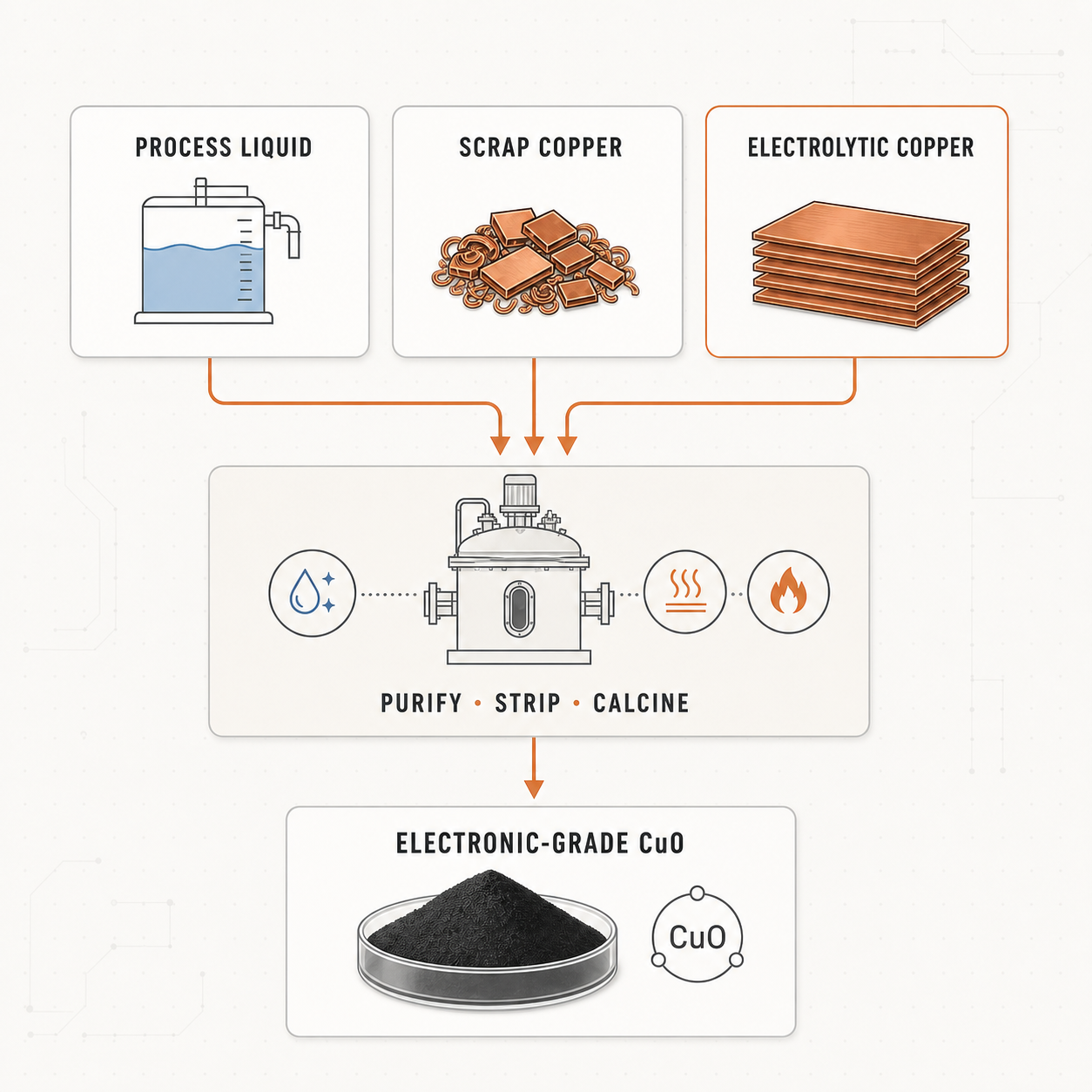
Three common feedstock routes are copper-bearing process liquids, scrap copper, and electrolytic copper.
Process-liquid and scrap-copper routes offer clear recycling and cost advantages, but usually require more extensive feedstock identification, purification, and consistency control.
Electrolytic copper provides a more defined and traceable starting material, helping reduce the incoming burden of metallic impurities and chloride-containing process residues.
Feedstock determines the starting point. Purification, ammonia stripping, washing, drying, calcination, and classification determine the final product.
In our previous article, we discussed the key factors buyers should evaluate when selecting electronic-grade copper oxide powder:
CuO content, acid-insoluble matter, chloride, metallic impurities, dissolution performance, and batch consistency.
These parameters do not suddenly appear when the finished powder reaches the laboratory.
Many of them begin much earlier—when the copper-bearing raw material first enters the production line.
Two copper oxide powders may look almost identical. Both may be fine black powders, and both may meet a basic CuO specification. Yet they may have been produced from very different copper sources.
Those sources can carry different metallic impurities, chloride compounds, organic additives, surface residues, and insoluble materials. As a result, each production route presents a different purification and quality-control challenge.
To understand electronic-grade copper oxide powder, it is therefore useful to ask a question that does not normally appear on a quotation:
What copper feedstock was used to manufacture this material?
A Brief Introduction to the Ammonia Stripping Process
Electronic-grade active copper oxide powder can be produced through several manufacturing methods. One established route uses copper-ammonia chemistry followed by ammonia stripping or ammonia distillation.
In simplified terms, copper is first converted into a soluble copper-ammonia complex. The solution is then heated, sometimes under reduced pressure, to remove and recover ammonia.
As ammonia leaves the solution, copper precipitates as an intermediate such as basic copper carbonate. That intermediate is separated, washed, dried, and calcined to produce copper oxide powder.
A simplified process flow is:
Copper feedstock → Copper-ammonia solution → Purification → Ammonia stripping → Basic copper carbonate → Filtration and washing → Drying and calcination → Copper oxide powder
Copper concentration, stripping temperature, pressure, agitation, reaction endpoint, drying, and calcination can all influence the final particle structure and dissolution behavior.
These process variables deserve a separate discussion. We will examine them in greater detail in our next article.
For now, the focus is on the first stage of the process: where the copper comes from.
Three Feedstock Routes—and Three Different Quality-Control Starting Points
Copper oxide manufacturing routes can be broadly grouped according to three types of copper feedstock:
Copper-bearing process liquids;
Scrap copper;
Electrolytic copper.
This classification does not mean that every manufacturer uses the same equipment or identical process sequence.
Some production lines add electrolysis, solvent extraction, crystallization, selective precipitation, or secondary dissolution before the material enters the copper-ammonia stage.
The three categories should therefore be understood as different feedstock starting points rather than three fixed manufacturing recipes.
Their differences extend beyond raw-material price. They also involve:
How clearly the feedstock composition is defined;
Which metallic and ionic impurities enter the process;
How chloride is introduced and removed;
How much pretreatment and purification are required;
How easily one batch can be kept consistent with the next;
How effectively the material can be traced from feedstock to finished product.
Route 1: Copper-Bearing Process Liquids
This route recovers copper from liquid streams generated by PCB or related manufacturing processes.
The most commonly documented examples are acidic and alkaline PCB etching solutions. These should not be confused with a normal production plating bath, although certain copper-bearing plating or cleaning streams may also be recovered after appropriate evaluation and treatment.
PCB etching solutions can retain substantial quantities of copper. Through ammonia stripping, precipitation, electrolysis, solvent extraction, or combined treatment processes, that copper can be recovered and converted into copper oxide or other copper compounds.
Advantages
The first advantage is resource recovery.
Instead of treating the copper in a spent process liquid solely as waste, a qualified recovery operation can return it to productive use. This reduces copper loss and supports a more circular use of metal resources.
The second advantage is that the copper may already exist in ionic or copper-ammonia complex form.
In certain processes, this can reduce or eliminate part of the metal-dissolution stage, creating potential operating and feedstock-cost benefits.
The third advantage is environmental value.
For manufacturers with the necessary treatment qualifications, stable feedstock sources, and well-controlled recovery systems, the process can combine waste treatment with copper-resource recovery.
Quality-Control Challenges
A copper-bearing process liquid is rarely a simple solution containing only copper and water.
Depending on its source, it may also contain:
Chloride and other ionic species;
Fe, Ni, Zn, Pb, Sn, or other metallic impurities;
Etching or plating additives;
Organic complexing agents;
Suspended solids;
Insoluble residues;
Copper in different oxidation states.
Chloride-based acidic and alkaline etching solutions require particular attention because chloride compounds are already part of the incoming chemical system.
This does not mean that process-liquid routes cannot produce low-chloride copper oxide. Advanced electrolysis, extraction, impurity removal, repeated washing, and secondary purification can significantly reduce contamination.
It does mean that the incoming chloride load must be identified and actively removed.
If the composition of the recovered liquid varies from one PCB plant, process, or collection batch to another, the copper oxide manufacturer may also need to retest the feedstock and adjust the purification process for each incoming lot.
The central capability of this route is therefore not simply recovering copper.
It is the ability to remove unwanted substances from a complex and potentially variable feedstock—consistently and repeatedly.
Route 2: Scrap Copper
The scrap-copper route begins with solid copper-bearing materials such as copper offcuts, wire, copper chips, rejected copper components, recovered copper, or other secondary copper materials.
After sorting, cleaning, and pretreatment, the copper can be dissolved or oxidized and converted into a copper salt or copper-ammonia solution before entering the remaining copper oxide production stages.
Advantages
Scrap copper offers a clear resource-efficiency benefit.
It allows usable copper to return to production rather than leaving the value chain. Compared with some liquid waste streams, solid copper is also easier to store, transport, inspect, and separate by source.
Clean copper offcuts from a known production process may provide a relatively manageable feedstock. Scrap copper can also offer a purchasing-cost advantage over refined primary copper.
Quality-Control Challenges
“Scrap copper” is not a single material grade.
Its composition depends heavily on where it comes from. Examples include:
Clean high-purity copper offcuts;
Copper wire and copper chips;
Machining scrap with oil or lubricant residues;
Copper with plated surface layers;
Mixed copper scrap;
Brass, bronze, solder-contaminated, or alloy-bearing materials.
If the material is not correctly identified and separated, Zn, Sn, Ni, Pb, Fe, and other elements may enter the dissolution stage.
Oils, oxides, coatings, solder residues, and surface contamination can also affect reaction behavior or increase the burden on filtration, washing, and acid-insoluble control.
The quality of a scrap-copper route therefore depends heavily on:
Whether the scrap source is fixed and documented;
Whether different copper grades are properly separated;
Whether oil, coatings, and surface residues are removed;
Whether the dissolved copper solution is purified;
Whether each incoming lot is tested before production.
Clean, traceable copper offcuts and mixed secondary copper should not be treated as equivalent feedstocks.
The term “scrap copper” alone provides too little information to evaluate the likely quality of the finished copper oxide powder.
Route 3: Electrolytic Copper
Electrolytic copper is produced through electrolytic refining and is supplied to a defined purity and composition standard.
In an ammonia-based copper oxide process, electrolytic copper can react with ammonia, carbon dioxide, and an oxidizing environment to form a copper-ammonia complex solution. The solution then proceeds through purification, ammonia stripping, separation, washing, drying, calcination, and particle classification.
Advantages
1. A More Defined Starting Composition
Compared with mixed scrap or variable process liquids, electrolytic copper offers a clearer and more consistent raw-material specification.
This makes it easier to establish incoming inspection requirements and repeatable production conditions.
2. A Lower Incoming Metallic-Impurity Burden
High-purity electrolytic copper generally contains low levels of Fe, Zn, Ni, Pb, and other metals.
Starting with fewer metallic impurities reduces the load placed on downstream purification and helps manufacturers maintain tighter finished-product controls.
It does not eliminate the need for purification or testing, but it creates a more controlled starting point.
3. Lower Exposure to Chloride-Bearing Feedstocks
Electrolytic copper is a metallic copper feedstock, not a chloride-based copper solution.
It therefore does not directly carry the same chloride compounds that may be present in acidic or alkaline PCB etching liquids.
When process water, ammonia, carbon dioxide, equipment, and handling systems are also properly controlled, this route can reduce chloride introduction at the feedstock stage.
However, electrolytic copper does not automatically guarantee a low-chloride finished product. Chloride may still enter through water, auxiliary chemicals, equipment residues, or cross-contamination.
The finished powder must still be verified by lot-specific testing.
4. More Direct Traceability
Electrolytic copper is normally supplied with defined producers, batches, and quality documentation.
If a production deviation occurs, the manufacturer can more directly investigate the raw material, dissolution stage, purification, ammonia stripping, washing, calcination, and packaging records.
Considerations
The most obvious consideration is cost.
The purchase price of electrolytic copper is closely linked to the refined copper market. Unlike certain waste-derived feedstocks, it does not begin with an immediate recovery-cost advantage.
Metallic copper must also be dissolved and converted into the required copper-ammonia chemistry before ammonia stripping can begin. Manufacturers must therefore manage dissolution efficiency, energy use, reaction time, and ammonia recovery.
The value of the electrolytic-copper route is not necessarily the lowest initial feedstock cost.
Its value lies in using a defined raw material to create more predictable impurity control, process conditions, and batch management.
Comparing the Three Routes
Evaluation AreaCopper-Bearing Process LiquidsScrap CopperElectrolytic CopperResource-recovery valueHighHighDepends on the upstream copper sourceFeedstock-cost positionOften favorableOften favorableClosely linked to refined copper pricesComposition consistencyDepends on liquid source and collection controlDepends on sorting and scrap gradeGenerally highMetallic-impurity controlRequires effective purificationInfluenced by alloys, coatings, and mixed scrapLower incoming burden in most casesChloride exposureA key concern for chloride-based streamsDepends on surface residues and pretreatmentGenerally lower at the feedstock stagePretreatment requirementsFiltration, impurity removal, decomplexing, extraction, or electrolysisSorting, degreasing, cleaning, and dissolutionIncoming inspection, cleaning, and dissolutionBatch traceabilityDepends on the waste-liquid collection systemDepends on scrap-source managementRelatively directConsistency potentialStrongly dependent on purification and process controlStrongly dependent on sorting and process controlEasier to establish a stable control windowPrincipal advantageCopper recovery and circular resource useFlexible use of secondary copper resourcesDefined composition and predictable controlPrincipal challengeComplexity and feedstock variationWide differences in scrap compositionFeedstock cost and dissolution efficiency
This comparison describes typical quality-control conditions. It does not mean that one route will always produce better or worse copper oxide powder.
A well-designed process-liquid recovery route can produce high-purity, low-chloride material. Conversely, an electrolytic-copper process can still experience contamination if process water, auxiliary chemicals, equipment cleaning, or washing are poorly controlled.
Feedstock defines the starting point. Manufacturing controls the transformation. The COA and production-bath evaluation verify the result.
Why Zhongan Copper Uses Electrolytic Copper
Zhongan Copper uses traceable electrolytic copper as the primary copper feedstock for its electronic-grade copper oxide powder.
This choice does not suggest that copper-recovery routes lack value. It reflects the intended application and quality-control priorities of our product.
Our electronic-grade CuO powder is designed for PCB, FPC, HDI, and related acid copper plating applications where metallic impurities, chloride, dissolution behavior, and batch consistency require close control.
Starting with defined and traceable electrolytic copper helps us:
Reduce the incoming load of Fe, Zn, Ni, Pb, and other metallic impurities;
Avoid directly inheriting the chloride burden of chloride-based etching liquids;
Establish more repeatable copper-dissolution and ammonia-stripping conditions;
Reduce production adjustments caused by variable feedstock composition;
Build clearer traceability from incoming copper to the finished lot.
Feedstock selection, however, is only the first stage of quality control.
Stable electronic-grade copper oxide powder also depends on controlling:
Ammonia, water, carbon dioxide, and auxiliary material quality;
Copper concentration and dissolution conditions;
Ammonia-stripping temperature, pressure, and endpoint;
Filtration and washing of the intermediate material;
Drying and calcination conditions;
Particle-size classification;
Packaging and cross-contamination prevention;
Lot-specific final-product testing.
Recent Zhongan Copper COAs have reported a chloride result of 5 ppm, with Fe, Zn, Ni, Pb, and other metallic impurities tested separately.
These values should not be viewed simply as isolated numbers from one document. They reflect a quality-control approach that begins with raw-material selection and continues throughout production.
All specifications and measured results remain subject to the COA for the delivered lot and the technical agreement confirmed by both parties.
One More Question Buyers Should Ask
When two suppliers offer similar CuO content and pricing, buyers can ask one additional question:
What copper feedstock do you use, and how do you control the impurities it may introduce?
Useful follow-up questions include:
Is the copper derived from process liquids, scrap copper, or electrolytic copper?
If recovered material is used, is its source fixed and documented?
Is every incoming feedstock lot tested?
How are metallic impurities and chloride removed or controlled?
Can the supplier provide COAs from consecutive production lots?
Are specification limits, typical values, and actual lot results clearly separated?
Can the finished product be traced back to the incoming copper feedstock?
The purpose is not to classify one feedstock as universally good and another as universally poor.
The more useful question is:
Does the supplier understand where its impurities come from, and can it control them consistently?
Conclusion
Quality differences in electronic-grade copper oxide powder often begin long before the material becomes a finished black powder.
Copper-bearing process-liquid routes support resource recovery but must manage complex chemical compositions and purification requirements.
Scrap-copper routes can balance recycling value and cost, but depend heavily on sorting, cleaning, and source consistency.
Electrolytic-copper routes have a higher and more market-sensitive feedstock cost, but provide a more defined, stable, and traceable starting point.
No feedstock can determine final quality by itself.
For electronic applications that require consistent control of metallic impurities, chloride, and batch performance, however, a clearly defined raw material can make the entire quality-management process more predictable.
Before reviewing the final COA, buyers may therefore want to ask:
What did this copper oxide powder start from?
FAQ
What raw materials are commonly used to manufacture copper oxide powder?
Common copper sources include electrolytic copper, clean copper scrap, recovered copper, acidic or alkaline PCB etching solutions, and copper salt intermediates.
The specific production route depends on the target product grade, available feedstock, purification system, and intended application.
What is the ammonia stripping process for copper oxide powder?
The process generally begins by forming a soluble copper-ammonia complex.
Heat or reduced pressure is then used to remove and recover ammonia, causing copper to precipitate as an intermediate such as basic copper carbonate. The intermediate is filtered, washed, dried, and calcined to produce copper oxide powder.
Is copper oxide made from recovered process liquids always lower in quality?
No.
Electrolysis, solvent extraction, selective impurity removal, repeated washing, and secondary purification can produce high-purity material from recovered copper-bearing liquids.
The main challenge is that the incoming composition may be more complex or variable, requiring stronger purification and batch-management controls.
Does electrolytic copper automatically guarantee low-chloride copper oxide?
No.
Electrolytic copper reduces chloride exposure at the raw-material stage, particularly compared with chloride-based etching liquids. Chloride can still enter through water, auxiliary chemicals, equipment, handling, or cross-contamination.
The finished product must be verified through lot-specific COA testing.
Why does copper feedstock matter in electronic-grade applications?
Copper feedstock may introduce Fe, Zn, Ni, Pb, chloride, organic substances, coatings, and insoluble residues.
A more clearly defined feedstock generally makes purification, traceability, and batch-consistency control easier to manage.
How can buyers verify a supplier’s feedstock-route claims?
Buyers can review incoming-material standards, consecutive COAs, analytical methods, impurity-control limits, traceability records, and small-scale production-trial results.
A feedstock claim becomes meaningful only when it is supported by consistent finished-product data.
This article was prepared by the technical team at Zhongan Copper.
Zhongan Copper uses traceable electrolytic copper as its primary copper feedstock and manufactures electronic-grade copper oxide powder through controlled copper dissolution, ammonia stripping, filtration, washing, drying, calcination, and particle classification.
Customers may contact our technical team to request product specifications, lot-specific COAs, particle-size reports, or plating-bath dissolution test data.
All product specifications and measured results are subject to the COA for the delivered lot and the technical agreement confirmed by both parties.