Copper Oxide and Basic Copper Carbonate: Composition, Calcination and Dissolution
Publication date: 2026-11-11 | Category: Copper Materials Purchasing Guide | Reading time: Approximately 8 minutes
Copper oxide powder and basic copper carbonate are different copper compounds. In suitable manufacturing routes, basic copper carbonate serves as a precursor that is converted to copper oxide through controlled calcination. Copper oxide powder intended for electronics manufacturing must also meet the relevant specifications for composition, impurities, acid-insoluble matter and dissolution behavior.
This relationship helps explain two purchasing questions. Why can the assay percentages for the two materials differ so much? And why can copper oxide powders with similar compositions exhibit different dissolution behavior? The first concerns the analytical quantity and chemical composition. The second involves the precursor, calcination conditions and subsequent powder processing.
A material producer's capability includes meeting agreed specifications and adjusting the manufacturing process to suit application requirements, with sample evaluation establishing whether the resulting product is suitable.
Composition and Specification Differences
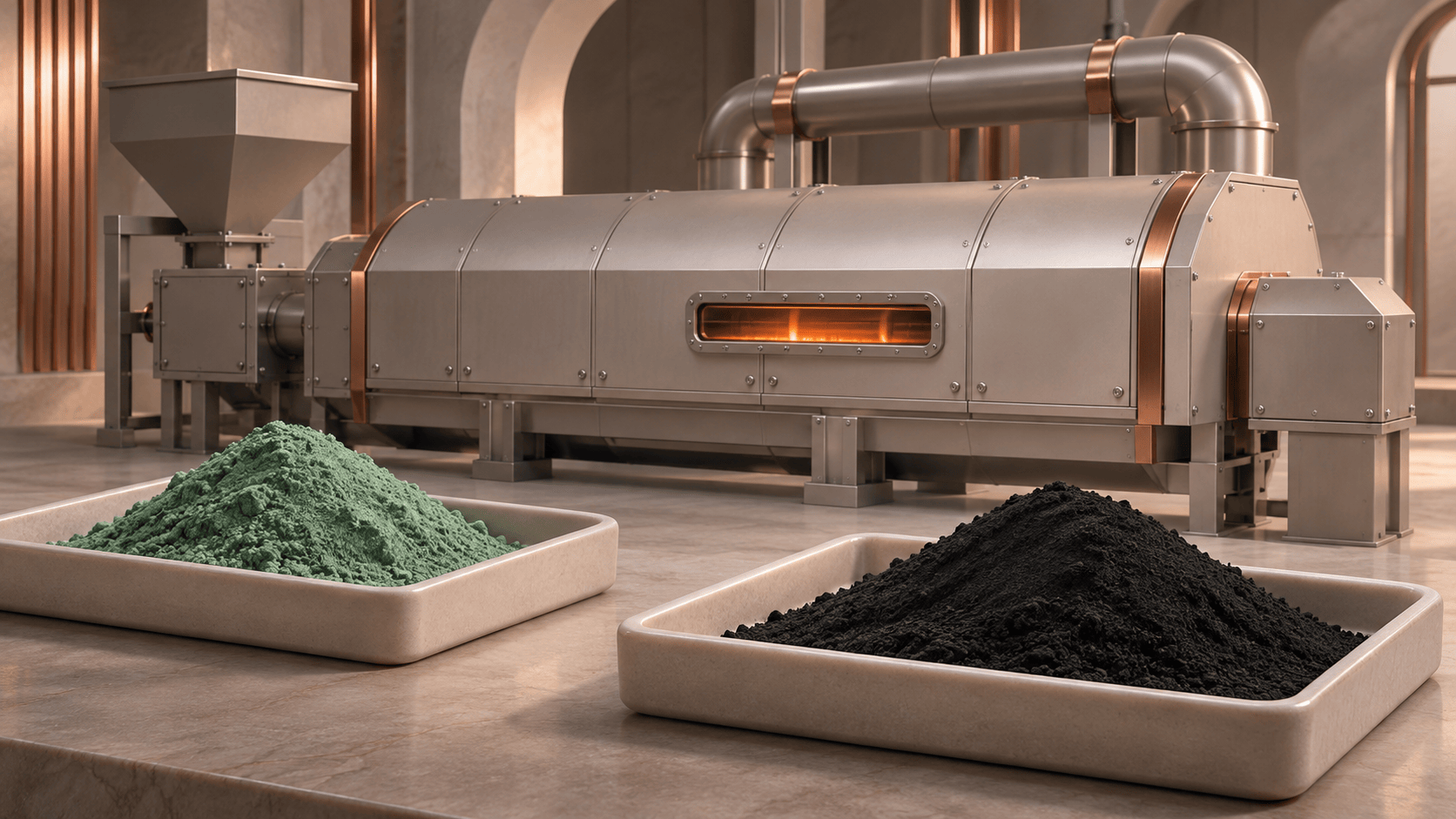
The copper oxide discussed here is CuO, also known as copper(II) oxide or cupric oxide, typically supplied as a black powder. Basic copper carbonate is represented here by Cu₂(OH)₂CO₃, also written as CuCO₃·Cu(OH)₂, and is typically a green powder.
Comparison | Copper oxide powder | Basic copper carbonate |
|---|---|---|
Chemical formula | CuO | Cu₂(OH)₂CO₃ |
CAS number | 1317-38-0 | 12069-69-1 |
Typical appearance | Black powder | Green powder |
Common assay basis | Copper oxide content, reported as CuO | Copper content, reported as Cu |
Role in the route discussed here | Target material after calcination | Precursor for CuO production |
Specification comparisons require a consistent assay basis. Zhongan Copper's published electronic-grade copper oxide specification gives a minimum CuO content of 99.00%. Its electronic-grade basic copper carbonate specification gives a minimum copper content of 56.00%, reported as elemental Cu. These percentages describe different analytical quantities, so a direct comparison does not establish which product has higher purity. Copper oxide specifications, basic copper carbonate specifications
An assay should identify the quantity measured, the test method and the reporting basis. If one report uses a dry basis and another reports the material as received, moisture and the calculation basis also need to be checked. Theoretical composition calculations can clarify the relationship between the quantities. Actual test results establish the quality of the batch.
Application requirements also guide material selection. Basic copper carbonate can serve as a feedstock for other copper compounds and certain catalyst and pigment materials. CuO has uses in compatible copper plating replenishment systems, copper compound preparation and other chemical applications. Buyers should establish the required chemical form and grade, then assess the relevant conditions of use.
Converting Basic Copper Carbonate to CuO
Basic copper carbonate can decompose on heating to form copper oxide, releasing carbon dioxide and water. For a Cu₂(OH)₂CO₃ precursor, the simplified reaction is:
Cu₂(OH)₂CO₃ → 2CuO + CO₂ + H₂O
Thermal analysis research shows that the decomposition behavior depends on the atmosphere and reaction conditions. Industrial calcination therefore needs to be established for the actual precursor and equipment. Research on basic copper carbonate decomposition
For electronic-grade copper oxide production, precursor quality and calcination control need to be considered together. Copper feedstock and auxiliary materials set the starting point for impurity control. Separation, washing and drying then determine the condition of the precursor entering calcination.
Where impurities remain in the precursor, subsequent heating cannot generally be relied on to remove them. Preparing an electronic-grade product requires quality control across the raw materials, precursor and finished powder, followed by testing against the specified requirements.
In Zhongan Copper's copper–ammonia manufacturing route, basic copper carbonate is the precursor between liquid-phase processing and final calcination. The existing manufacturing article covers feedstock treatment, ammonia stripping and washing in more detail. Copper oxide manufacturing process
How Calcination Affects Copper Oxide Powder
Calcination involves both chemical conversion and the development of powder properties.
Chemical assessment establishes whether the precursor has formed the required copper oxide product. Powder assessment considers structural changes during heating and their implications for subsequent processing and use.
Temperature and residence time are related process variables. Different combinations applied to the same precursor can produce differences in particle structure and reactivity. Published copper oxide preparation technology also discusses the relationship between calcination conditions and dissolution behavior. Its specific results apply to the feedstocks and test conditions described. Published copper oxide preparation technology
Process adjustments consequently require checks on both conversion and finished-product performance. Reducing the calcination temperature while extending the calcination time is one possible approach. Sample testing is needed to determine whether that combination suits a particular precursor and how the resulting powder dissolves.
More intensive heat treatment may alter particle sintering and surface condition. Insufficient treatment may affect complete conversion of the precursor. Production control needs an appropriate operating range, coordinated with subsequent milling, screening and finished-product inspection.
Two powders with similar CuO assay results therefore still require their own dissolution assessments. Composition data and application performance provide different information.
Defining Dissolution Requirements
An evaluation method is needed before a dissolution rate can be compared or specified.
The same powder can give different results in different acid solutions or copper-containing solutions. Solution composition, temperature, powder loading, agitation and the endpoint all affect the recorded dissolution time. A time expressed in seconds, without those conditions, gives buyers limited scope for a meaningful supplier comparison.
The following information can establish a common basis for technical discussions.
Test detail | Purpose |
|---|---|
Test medium and composition | Identify the solution conditions represented by the result |
Test temperature | Establish comparable thermal conditions |
Sample mass and solution quantity | Define the test loading |
Agitation and addition method | Keep operating conditions comparable |
Dissolution endpoint | Define when timing ends |
Residue assessment | Distinguish the dissolution-time result from the residue result |
Dissolution time and acid-insoluble matter also need separate records. Reaching an observation endpoint quickly does not, on its own, establish that the residue meets specification. Likewise, a low acid-insoluble result does not fully characterize the dissolution process.
For PCB acid copper replenishment, a basic acid-dissolution test and evaluation in the intended plating bath serve different purposes. The former supports material comparison under defined conditions. The latter assesses suitability in relation to the intended medium and application requirements. The existing comparison article explains the distinction in more detail. Acid dissolution and plating-bath dissolution
Agreeing these conditions allows the customer's requirement to be expressed as a material characteristic that the producer can assess, adjust and verify.
Adjusting Dissolution Behavior at Zhongan Copper
Zhongan Copper can adjust the calcination process within an applicable operating range to address agreed dissolution requirements for the finished copper oxide powder. The relationship between temperature and time is one of the available controls. For example, a lower calcination temperature combined with a longer calcination time can be evaluated as part of that adjustment.
This capability connects application requirements with manufacturing conditions. During project discussions, the intended medium, test method, dissolution requirements and other quality criteria can be used to establish the basis for sample evaluation. Testing then determines whether the adjusted product is suitable.
Chemical quality requirements remain part of the assessment. When adjusting dissolution behavior, the agreed CuO assay, impurity limits, acid-insoluble matter and relevant powder characteristics also need to be checked so that sample evaluation covers the principal purchasing requirements.
Customers with defined dissolution requirements can provide their application medium, current test method, target range and impurity limits. These details support discussions with Zhongan Copper about product suitability. Sample results and the agreed specification can then establish the requirements for subsequent supply.
The achievable adjustment range is assessed against the requirements of the particular project, using the agreed process and sample evaluation conditions.
Specifying the Material for Purchase
The choice between basic copper carbonate and copper oxide powder begins with the role of the material in the customer's process. For further copper compound preparation or use as a precursor in a specified route, basic copper carbonate should be assessed against the relevant composition and quality requirements. Where the process already calls for CuO, evaluation should focus on the copper oxide specification and conditions of use.
Purchasing information can be organized around four areas.
Material identity and assay basis. State the full name, chemical formula and whether the principal assay is reported as Cu or CuO. Where moisture or dry-basis reporting matters, specify the test and calculation basis.
Chemical quality. Identify the impurities and acid-insoluble matter requirements relevant to the application, including methods, units and limits.
Dissolution evaluation. Define the test medium, temperature, sample quantity, procedure and endpoint so that sample results can be assessed against the target.
Sample and batch documentation. Match sample identification, product grade, test reports and subsequent supply specifications. Published specifications support preliminary comparisons. Supply should be checked against the applicable batch COA and agreed requirements.
The conversion of basic copper carbonate to copper oxide gives the producer a manufacturing stage at which finished-powder properties can be adjusted. For projects with specific dissolution requirements, clear material criteria and evaluation methods help turn those requirements into verifiable product specifications.
Zhongan Copper supplies basic copper carbonate and electronic-grade copper oxide powder. Customers can review the published information and provide their application, quality criteria and dissolution test requirements to discuss material selection and sample evaluation with the technical team. Published product and technical documents